
Matching into a US residency is the goal for thousands of international medical graduates every year. The training, the pay, the career it opens up. It’s worth chasing. But here’s what trips up a lot of smart people, they know the exams, yet they don’t know the order things happen in. That’s what costs them a year. This guide isn’t another exam breakdown. It’s about planning the whole journey, from the day you finish MBBS to the day you match.
What Does the USMLE Roadmap Look Like?
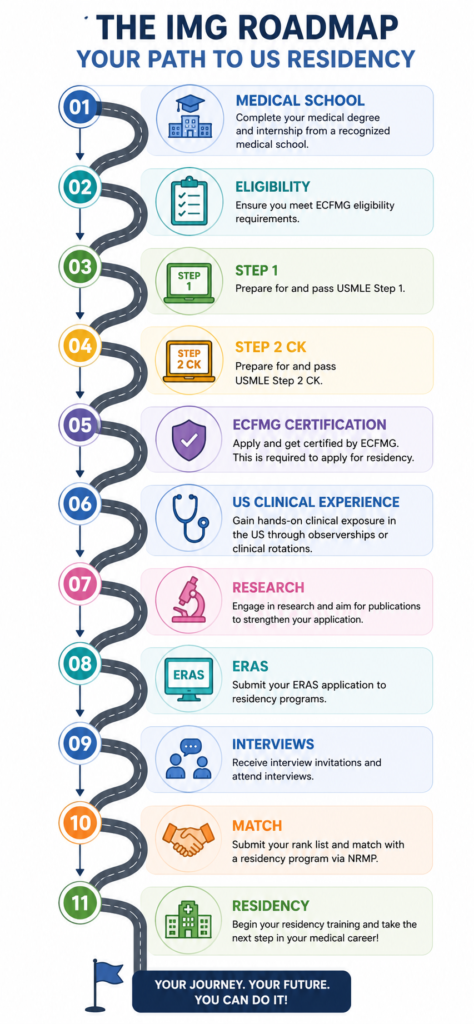
The complete USMLE roadmap is really one long pathway, and every stage feeds the next. It starts back in medical school, where your studies lay the base. From there you confirm your eligibility, then sit Step 1, followed by Step 2 CK. Once your exams are done, you work toward ECFMG certification. Alongside that, you build up US clinical experience and add research where it helps. All of this comes together in your ERAS application, which goes out to programs. The ones that like your file invite you to interview. After the interviews, you rank your favorites, and the Match pairs you with a program. Then residency begins.
So the IMG roadmap to residency, in order, runs like this: medical school, eligibility, Step 1, Step 2 CK, ECFMG certification, US clinical experience, research, ERAS, interviews, Match, residency. The sequence matters more than most people expect. Skip ahead or fall behind on one piece, and the whole path to US residency can stall.
Before You Start Your USMLE Journey
Before you spend money on anything, sort out a few basics. This is how to start your USMLE journey the right way.
First, check that your medical school is recognized. It needs to be listed in the World Directory of Medical Schools with an ECFMG sponsor note that covers your graduation year. No note, no certification later, so confirm this early.
Next, your passport. The name on it has to match your school records exactly. Even one small spelling difference can hold you up for weeks, so fix any mismatch before it becomes a problem.
You’ll also set up a MyIntealth account. This is the online portal you’ll use for certification, so create it and keep your login safe.
Then think about money. Between exams, fees, and applications, most IMGs spend a few thousand dollars, and that’s before travel or clinical experience. Plan for it so you’re not stuck halfway.
Finally, be honest about time. For most people this is a one to two year commitment, not a few months.
One misconception worth killing right now: a great Step score alone won’t get you matched. It helps, but programs look at the whole picture. Another myth is that you have to finish everything before you graduate. You don’t. You can start as a student and complete the rest after MBBS.
Phase 1: Build a Strong Foundation (Step 1 Preparation)
Step 1 is where your USMLE timeline for IMGs really begins. It’s pass/fail now, so there’s no score to chase. Passing is the whole job. But don’t treat it as easy. A solid Step 1 base makes everything after it, especially Step 2 CK, far smoother.
When to start
The best time to begin is during medical school, while the basic sciences are still fresh. Many IMGs start light in their third or fourth year and build from there. If you’ve already graduated, that’s fine too. You’ll just plan a focused block instead, our 3, 6, and 12-month Step 1 study plans map out what that looks like at each pace.
How long to prepare
If you’re in your final year, expect around four to six months of steady prep. If you’ve graduated and can study full-time, six to nine months is common. Your pace depends on your schedule and how much ground you need to cover, here’s how long you really need to study for the USMLE based on where you’re starting from.
Balancing medical school
Prepping hard while classes and rotations pile up is tough. The trick is small, consistent effort. A set number of questions a day beats cramming on weekends. Treat Step 1 as a slow build, not a sprint.
Recommended resources
You don’t need a huge stack of materials. First Aid for Step 1 as your review book, UWorld as your question bank, and Anki flashcards to hold on to facts. That’s enough. Pick a few and use them well instead of collecting ten you never finish.
Study strategy
Questions come first. Do them, then actually learn from the ones you get wrong. That’s where the real progress happens.
Dedicated period
Near the end, block off a dedicated study period of four to six weeks. No distractions, just review and practice tests. This final stretch is what carries you from Step 1 toward the Match with real confidence.
American Academy of Research & Academics
Build the academic foundation the rest of the roadmap leans on.
Research methodology, biostatistics, and review modules, taught for IMGs, wherever you are in the world.
Phase 2: Focus on Step 2 CK: The Most Important Exam for IMGs
If Step 1 opens the door, Step 2 CK decides how far you get through it. Since Step 1 went pass/fail, Step 2 CK is the only USMLE exam that gives you a number. Program directors know this, and they lean on that number hard. For an IMG, a strong Step 2 CK score is one of the clearest ways to stand out.
Ideal timing
Timing is everything here. You want your score in hand before ERAS goes out in September. That means sitting the exam in your final year or soon after graduating. Leave it too late and you risk applying without a score, which badly weakens your file. This is one of the most common places IMGs stumble.
Score goals by specialty
Aim high. Recent Match data puts the average Step 2 CK score for matched non-US IMGs around 245. Going for something competitive like surgery or dermatology? Target 250 or higher. For the matched-applicant benchmarks field by field, see Step 1 and Step 2 CK average scores by specialty. A score in the low 230s will pass, but then the rest of your application has to work overtime to make up for it. As a rule, higher scores bring more interview invites.
Balancing electives with preparation
Many IMGs try to do clinical electives and Step 2 prep at the same time. It can work, but be realistic. Rotations are draining. If you take both on at once, guard your study time and don’t let either one slip.
Avoiding delayed applications
The single biggest Step 2 mistake is delaying it. A late score can push your whole application past deadlines, and program directors often won’t open a file that’s missing its main number. Plan backward from September, and give this exam the priority it deserves.
Phase 3: Complete ECFMG Certification
ECFMG certification is the official sign that you’re ready to enter US residency as an IMG. Without it, you can’t join the Match. Here are the ECFMG certification steps in plain terms.
Intealth and your account
ECFMG now runs under Intealth, and you handle everything through your MyIntealth account. This is where you apply, upload documents, and track your progress.
Credential verification
ECFMG confirms your diploma directly with your medical school. You can begin this as a student, but it can’t finish until you’ve graduated and your diploma is verified. This step takes time, so start it early.
Pathways and OET
The old clinical skills exam is gone. In its place, ECFMG uses Pathways to confirm your clinical and communication skills. Whichever Pathway fits you, every applicant also needs a passing score on the OET Medicine English test. Pathways run on a seasonal cycle, so watch the deadlines closely.
Certification timeline
Certification usually overlaps with your later exams and clinical work rather than sitting on its own. Because verification and Pathways both eat up weeks, starting late here is one of the most common reasons IMGs lose a full Match cycle. Get the paperwork moving as soon as you can.
Phase 4: Build a Residency-Ready CV
Good scores get your foot in the door. They won’t carry you the rest of the way. Programs want proof you can work inside the US system, and that’s what your CV shows. Here’s how to think about priorities.
US Clinical Experience
This is the big one. US clinical experience, or USCE, tells programs you can function in an American hospital. Observerships, externships, and hands-on clerkships all count, with the hands-on kind counting for more. Line these up early.
Letters of Recommendation
Strong letters carry serious weight, especially US-based ones from doctors who’ve actually supervised you. Aim for letters that speak to your clinical skills and how you work, not generic praise.
Research
Research shows you can think critically. Case reports, posters, and articles all count. It matters most for competitive specialties and research-heavy programs. For less competitive fields, don’t lose sleep over it.
Volunteer Experience
Volunteering shows you care about patients and community. It’s a nice addition, not a make-or-break piece.
Leadership
Leading a student group or running an event shows you can handle responsibility. Even small roles count.
Networking
Networking is how you find mentors, rotations, and letters. Stay in touch with the doctors you work under, and get to conferences when you can.
What matters most?
If your time is limited, put it into US clinical experience and strong letters first. Those two move the needle more than anything else for most IMGs.
American Academy of Research & Academics
Research isn’t mandatory. For competitive specialties, it’s decisive.
AARA gives IMGs the methodology, biostatistics, and mentorship to finish a project you can defend in an interview.
Phase 5: Prepare for ERAS and Residency Applications
ERAS is the system that sends your application to programs. It’s the point where every part of your residency match roadmap comes together.
Personal statement
This short essay is where the real you shows up, past the numbers. Write about why you chose your specialty and what you’d bring to it. Start early and rewrite it more than once.
Experience
List your clinical, research, work, and volunteer activities. Be specific about what you did, not just where you were.
CV
Your CV is built from what you enter in ERAS, so keep it clean and honest.
LORs
Your letter writers upload their letters straight into the system. Give them plenty of notice so nothing arrives late.
Program signals
You get a limited number of signals to flag real interest in specific programs. Use them on places you genuinely want, not long shots.
Choosing specialties and applying broadly
Betting everything on one competitive specialty is risky. If your profile is borderline, think about a backup field. And don’t apply too narrowly. Cast a wide enough net so a few missed programs don’t sink your cycle. ERAS opens in June and submissions start in September, so use the summer to get everything ready and submit on day one.
Sample USMLE Timeline for IMGs
Here’s a realistic timeline you can adjust to your own pace. The months are counted from the day you start Step 1 prep.
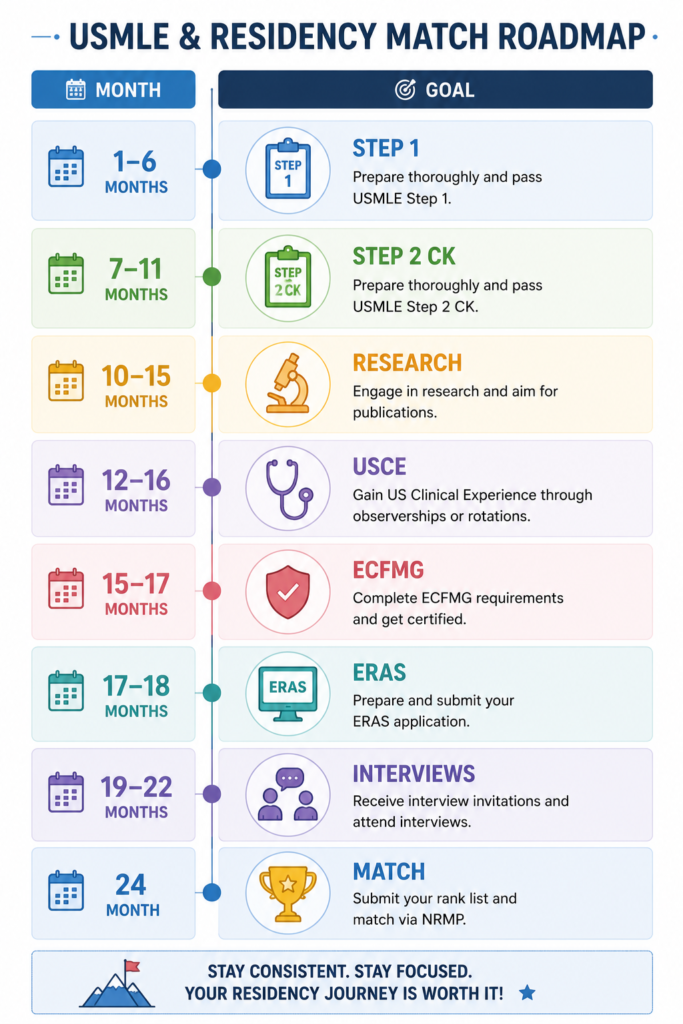
A few things to notice. Research, clinical experience, and certification overlap on purpose. They don’t sit in neat separate blocks. Start research small and keep building it alongside your exams. Kick off ECFMG credential verification and your Pathway early, since both can drag on for months.
Also notice where ERAS falls, right after Step 2 CK and your first stretch of clinical experience. Everything before that is really just groundwork for the application. Some IMGs move faster, others need more runway. What counts is holding the order and not skipping steps. Pace yourself, and you won’t be scrambling at the end and risking a whole Match cycle.
Common Mistakes That Delay the USMLE Journey
Even sharp applicants slip up. Here are the mistakes that push the journey off track most often.
Starting too late.
The later you begin, the more you have to rush later on. Give yourself room from the start.
Poor financial planning.
Running out of money halfway is a real risk. Map out the full cost before you commit.
Ignoring research completely.
You don’t always need it, but for competitive fields, none at all can hurt. Add a little where it fits.
Weak letters of recommendation.
Generic letters from people who barely know you do little. Build real relationships with your supervisors.
Waiting too long for Step 2 CK.
This is the classic one. A late score weakens or delays your whole application.
Missing ERAS deadlines.
Late documents cost you interviews, plain and simple. Track every date and submit early.
No backup specialty.
Betting everything on one competitive field is risky. Have a realistic plan B if your profile is borderline.
Frequently Asked Questions
Q1. How long does the USMLE journey take?
For most IMGs, about one to two years, from your first day of Step 1 prep to Match Day. Your pace and exam timing can stretch or shrink that.
Q2. Can I start after MBBS?
Yes. Plenty of IMGs take Step 1 during medical school and finish the rest after MBBS. You can also start the whole thing after graduating. Just remember, ECFMG certification can’t wrap up until your diploma is verified.
Q3. Is research mandatory?
No. You can match without research. It helps for competitive specialties and research-focused programs, but for less competitive fields, clinical experience and strong letters count for more. If you’re weighing how much to invest, our breakdown of whether publications really matter for the Match covers what program directors actually look at and how many projects are enough.
Q4. Can I match without US clinical experience?
It’s possible, just harder. US experience reassures programs that you can work in their system, and most IMGs who match have at least some of it. Try to get a little if you can.
Q5. Should I take Step 3 before applying?
For most people, no. Many IMGs take Step 3 during their first year of residency. Some do it earlier because passing it can help with certain visa options, but it isn’t required to apply.
Q6. How much does the USMLE pathway cost?
It varies, but many IMGs spend somewhere between $3,400 and $5,000 on exams, ECFMG fees, and applications. Travel, clinical experience, and study materials push that higher.
Q7. Can I work while preparing?
Yes, and many do. Just be realistic about your energy. If you’re working, plan a longer prep window and protect your study time so neither one suffers.
American Academy of Research & Academics
Step 1 and Step 2 CK don’t reward the same study plan. Stop using one.
Step 1 needs a deep, concept-based strategy. Step 2 CK needs clinical judgment and speed. AARA’s USMLE Preparation Course builds each one separately, with mentors who have passed these exams, a syllabus that won’t drown you in resources, and system-wise crash courses that mirror how you’ll actually think on test day.
Final Thoughts
There’s a lot between MBBS and a US residency, but you don’t face it all at once. Think in milestones, not one giant mountain. Confirm your eligibility, pass your exams, get certified, build your experience, and apply with care. One stage at a time, thousands of IMGs finish this every year, and you can too.
If you’d rather not navigate this roadmap alone, the American Academy of Research & Academics is here to help. We support IMGs with expert-led USMLE preparation, hands-on research training, from methodology and biostatistics to systematic and narrative reviews, and a dedicated Residency Match Guide to strengthen your application. Visit our website to see how we can help you match.
Disclaimer:
Articles published by American Academy of Research & Academics are prepared by our team using information from direct experience, publicly available resources, and educational references. AI tools may be used to assist with drafting, proofreading, and formatting; however, all content undergoes review and approval before publication.
The information provided is intended for educational purposes only. Requirements, policies, and processes may change over time. Readers should consult official sources for the most current information.