Step 1 doesn’t give you a number anymore. Just Pass or Fail.
If that leaves you unsure where you stand as an IMG, you’re in good company. The same questions come up over and over. Does the exam still count for anything? Is Step 2 CK the thing that decides everything now? And what happens if you fail it?
In This guide American Academy of Research & Academics walk you through all of that, why the change happened, what program directors actually weigh today, how IMGs are affected differently from US students, and what your options are if Step 1 goes badly.
Why Did USMLE Step 1 Become Pass/Fail?
This didn’t happen overnight. USMLE announced the plan in February 2020, and the step 1 pass fail change took effect on January 26, 2022. Test on or after that date and you get a Pass or a Fail. Nothing else.
The reasoning makes sense once you look at what that score had turned into.
Programs were drowning in applications. A three-digit number gave them a fast way to cut the pile down, so the number started deciding careers. Students noticed, obviously. An entire study culture grew up around squeezing out five more points, and actually understanding the material slid into second place.
The usmle step 1 pass fail decision was meant to push back on three things at once: the arms race between applicants, the habit of screening people by a single test, and the mental health cost of both. Whether it fully worked is still argued about. But that was the intention.
Does Step 1 Still Matter for Residency?
Yes. Just not the way it used to.
Start with the part nobody can argue with. You need a pass to become ECFMG certified, and you need ECFMG certification to enter the Match. No pass, no application. That will never change.
Then there’s screening. Coordinators still set filters in ERAS, and one of the first ones is whether you passed, and whether you passed on the first try. So when people ask does step 1 still matter, the real answer is that it became a gate instead of a scoreboard. You get through it or you don’t.
Your attempt history goes to programs too. They can see how many tries it took. That one line is why Step 1 keeps showing up in img match pass fail threads years after the score disappeared.
There’s a quieter reason as well. The content itself doesn’t expire. Pathology and pharmacology don’t stop mattering the day your exam ends, and people who genuinely learned that material tend to find Step 2 CK preparation a lot smoother.
So Step 1’s place in residency selection criteria moved rather than vanished. It used to be a way to stand out. Now it’s a box to check. You can’t gain much from it anymore, but you can absolutely lose ground.
Why Step 2 CK Is More Important Than Ever
Take away the Step 1 score and programs lose their quickest way to sort people. They didn’t respond by sorting less. They reached for the next number on the page.
That number is Step 2 CK, which is why step 2 ck importance has climbed so fast since 2022. It’s the only USMLE score anyone can compare you on. For IMGs, it often decides whether your file gets opened at all.
Everything filling the gap around it is clinical. Your Step 2 CK score comes first and loudest. Then clinical evaluations, meaning what supervisors wrote about you after watching you work, and clerkship grades across your core rotations. US clinical experience carries real weight here, because programs want evidence you can function in an American hospital specifically, not just a hospital. Research helps most when it’s in the specialty you’re applying to. And letters of recommendation land hardest when a US physician who actually supervised you wrote them.
There’s a trap worth naming. Under the old residency selection criteria, a mediocre Step 1 could be rescued by a strong Step 2 CK. That rescue only ever worked in one direction, and now the first half of the equation is gone.
Plan around that. Step 2 CK is your main exam, not the follow-up to Step 1. If your practice scores aren’t where you need them, applying a little later usually costs you less than a weak score does.
USMLE Preparation Course
Step 2 CK is now the score that decides.
If it carries the weight Step 1 used to, it deserves the preparation Step 1 used to get. Our mentors build your timeline around your real baseline, review every NBME with you, and tell you honestly when you’re ready to sit.
What Program Directors Look at After Step 1 Became Pass/Fail
The NRMP program director survey is the closest thing we have to a straight answer. Read through recent editions and the same pattern shows up: with no Step 1 score to sort by, directors lean on Step 2 CK to decide who gets an interview, then spend their attention on the parts of your file that describe you as a physician rather than a test taker.
What keeps surfacing:
- Step 2 CK, used as the objective screen
- Letters of recommendation, where detailed beats famous every time
- MSPE, which pulls your whole medical school record into one place
- Clerkship grades and clinical performance
- Personal statement, read mostly for fit and for red flags
- Research and publications
- US clinical experience
- Professionalism and communication, judged mainly on interview day
Roughly how they stack up:
| Ranking | Factor |
| 1 | Step 2 CK |
| 2 | Letters of Recommendation |
| 3 | Clinical Performance |
| 4 | MSPE |
| 5 | Research |
| 6 | USCE |
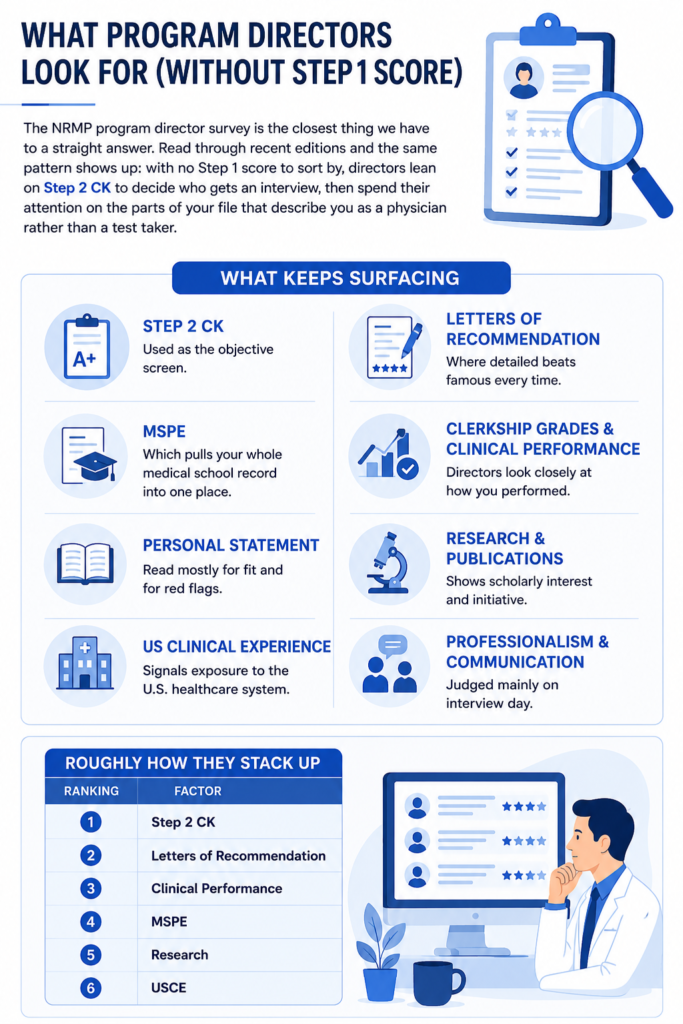
Two things stand out. Four of those six have nothing to do with exams and everything to do with how you handle patients. And the criteria that win you an interview aren’t the same ones that move you up a rank list. Interviews are won on paper. Rank position is won in a room, talking to people.
Research Methodology
Research sits at number five on that list.
It’s also the only factor on it you can build from anywhere in the world, starting this month. Learn study design, PICO framing and chart review properly, then work toward output you can defend in an interview.
Is Pass/Fail Different for IMGs Than US Medical Students?
Same rule for everyone. Very different consequences.
US students already had a support system in place. Faculty who’ve known them for years and can write about them in detail. Clerkships in US hospitals, arranged for them. Research sitting a corridor away from their lecture hall. When the Step 1 number disappeared, they still had five other ways to prove themselves.
Most IMGs are building all of that from nothing, which is why the usmle step 1 pass fail img conversation hits harder on our side. There’s no score to lead with, so the rest of the application has to carry the whole weight: a competitive Step 2 CK, US clinical experience with real patient contact, research you can talk about confidently, letters from US-based physicians, and a network you assembled yourself through LinkedIn, conferences, and emails nobody asked you to send.
That’s a longer list than US students face. It isn’t an impossible one. IMGs match in large numbers every year. The img match pass fail reality is simply that nobody hands you the pieces, so you have to start collecting them early.
Residency Match Guide for IMGs
Nobody hands an IMG the pieces.
US clinical experience, letters from American physicians, research, ERAS timelines and a network you build yourself. Our roadmap puts them in order and tells you when each one needs to be underway.
What Happens If You Fail Step 1?
A failure hurts. It doesn’t end anything.
Here’s the situation as it actually is. Programs see your attempts. Some filter out anyone with a failure, and there’s no talking about those programs around. Plenty of others don’t filter at all. IMGs with a first-attempt failure match every year, and the ones who do almost always have an application strong enough that the failure reads like one bad day instead of a warning sign.
That’s really the only question being asked. Did you fix it? A failure followed by a clean pass and a solid Step 2 CK tells a completely different story from a failure followed by more weak results.
So if you’re up at 2 a.m. searching failed step 1 what to do img, this is where the energy goes. Pass the retake, because everything else is secondary until that’s done. Score well on Step 2 CK, since that’s your evidence. Get clinical experience and letters from people who watched you work. And have a two-sentence explanation ready in case someone asks, honest, short, no excuses.
IMG step 1 failure recovery gets decided by the next twelve months, not by one afternoon at a testing center.
How to Prepare for a Successful Step 1 Retake
Sitting the same exam with the same preparation tends to produce the same result. Build a real step 1 repeat attempt plan before you book anything.
Start by figuring out what actually broke. Content gaps? Timing? Anxiety in the chair? Not enough practice questions? Put your score report next to your last NBME and look at both honestly. Most failures come down to shaky fundamentals plus too few question blocks. Genuine bad luck is rare.
Then set a timeline. Three to six months is the usual range. If you were sitting just under the line, three is realistic. If you were well below it, or your basics need rebuilding from the ground up, take the six and stop negotiating with yourself about it.
Your schedule needs to be one you can hold for months, not one that looks impressive written down. Six focused hours a day beats twelve scattered ones. Keep one lighter day each week or you’ll be running on empty by week eight.
Use NBMEs as checkpoints rather than mood boosters. One early for a baseline, then every two to three weeks. Review every wrong answer, and include the ones you got right by guessing, because those are gaps you haven’t noticed yet.
Weak subjects first. Revising what you already know feels productive and isn’t.
And if your practice scores say you’re not ready, move the date. A delay costs you a few weeks. A second failure stays on your record permanently. Most USMLE step 1 second attempt tips circle back to the same idea anyway: consistency wins this.
Talk it through
Working out what went wrong is hard to do alone.
Bring your score report and your last NBME to our team. A mentor will help you read them honestly, work out whether three months or six is realistic, and plan the rest of the file around it.
Frequently Asked Questions
Q1. Does Step 1 still matter after becoming pass/fail?
It does. You can’t get ECFMG certified without passing, and programs still see how many attempts you needed. What it no longer does is help you stand out from anyone.
Q2. Can I match after failing Step ?
Yes, and IMGs do every year. A failure closes some doors permanently. A strong Step 2 CK, real US clinical experience, and good letters keep plenty of others open.
Q3. Is Step 2 CK more important than Step 1?
For residency selection, yes. It’s the only USMLE score programs can compare you on, so it inherited most of the weight Step 1 used to carry.
Q4. Should IMGs take Step 2 CK immediately after Step 1?
Not by default. Take it when your practice scores are where you want them. A rushed, weak Step 2 CK does more damage than applying a bit later.
Q5. How long should I study before retaking Step 1?
Usually three to six months, depending on how far below the pass line you landed and how solid your fundamentals actually are.
Conclusion
Step 1 still matters. It just matters quietly now. You have to pass it, programs can see how many attempts it took, and the material underneath it props up every exam that comes after. What it no longer does is set you apart from anybody.
Step 2 CK took over that job, with clinical experience, letters, and research filling in around it. Applications get read as a whole more than they once were, and that works in your favor when yours is complete.A failure is a setback, not a verdict. Start early, build the rest of the file, and keep moving.
AARA Membership
Build the rest of the file.
Step 1 is a gate, not a scoreboard. Everything that ranks you comes after it. One membership covers USMLE preparation, research methodology, biostatistics and systematic review, plus mentor access.
Disclaimer:
Articles published by American Academy of Research & Academics are prepared by our team using information from direct experience, publicly available resources, and educational references. AI tools may be used to assist with drafting, proofreading, and formatting; however, all content undergoes review and approval before publication.
The information provided is intended for educational purposes only. Requirements, policies, and processes may change over time. Readers should consult official sources for the most current information.