
Let’s be honest. Getting on a research project as an IMG is tough. Most of us don’t have a US mentor on speed dial or a big-name institution behind our name, so the whole thing can feel like a locked door. It isn’t. The opportunities are out there. You just have to go after them the right way, which means not buying your way onto a paper and not taking credit you didn’t work for.
Why Research Matters for IMGs
Do you actually need research? Depends. Going for family medicine or something less competitive? A couple of decent projects will do. But if you’re eyeing internal medicine at a strong program, or a competitive field like derm, neuro, or surgery, then yes, it counts. A lot.
It’s not only about your CV, though. Research puts you in a room with people who matter in your field, and those are the people who write the letters that carry weight. You pick up how to actually read a study instead of skimming the abstract. And when interview day rolls around, you’ve got real work to talk about instead of scrambling for something to say.
Quick reminder, though. Two or three projects you genuinely worked on beat a wall of names you barely touched.
What “Ethical Research Participation” Actually Means
Here’s the simple version. You do the work, and your name goes on only if you earned it. Most journals follow the ICMJE rules, which basically say an author should help plan or analyze the study, help write or fix the paper, sign off on the final draft, and be willing to stand behind it. Miss those, and you don’t belong on the byline.
There’s also the quieter stuff. Keep patient data confidential. Don’t inflate your experience or claim skills you’re still learning.
And then the things you never touch. Paying for authorship. Getting handed a spot on a paper you never opened. Fake research certificates. Padding your CV with projects that didn’t happen. Nudging the numbers to get the result you wanted. That’s not a shortcut. It’s a career risk.
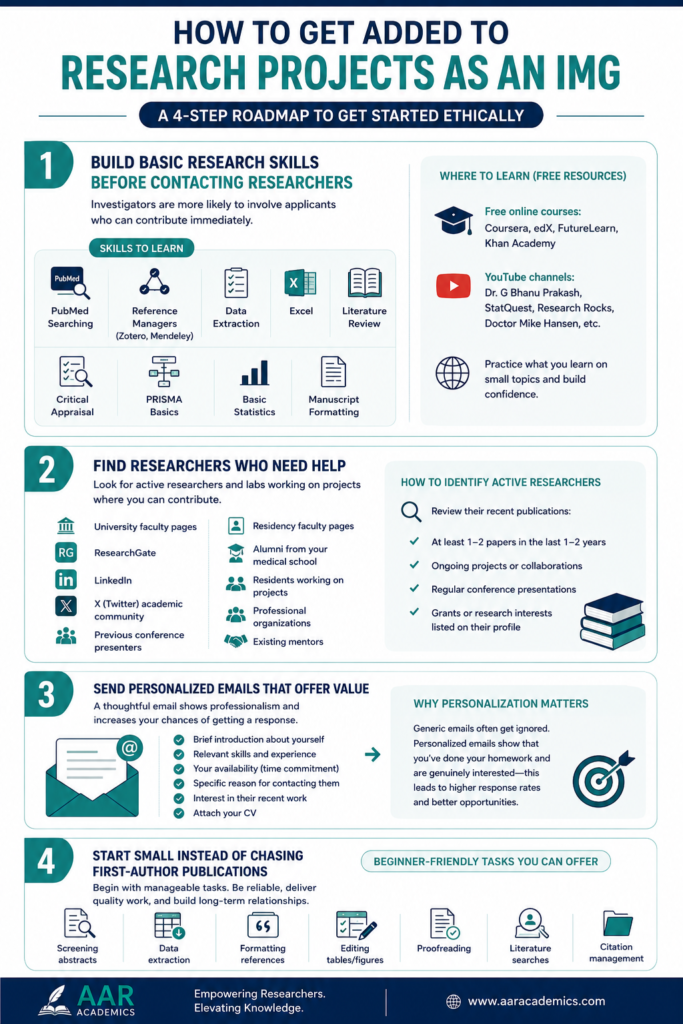
Step 1: Build Basic Research Skills Before Contacting Researchers
Most beginners skip this part and pay for it later. The truth is, investigators want someone who can jump in and help now. They don’t have the time to teach you the basics. So if you already know the ropes, you go straight to the top of the pile.
Start with a handful of core skills. Learn to search PubMed properly, not just typing a word and hoping. Pick a reference manager, Zotero or Mendeley, so you’re not formatting citations by hand at midnight. Get quick at pulling data out of papers and dropping it into Excel. Learn how a literature review actually works, and how to look at a study and tell whether the evidence holds up.
Into systematic reviews? Then get the hang of PRISMA, the roadmap those reviews follow. A bit of stats won’t hurt either. Even knowing what a p-value means puts you ahead. And spend some time seeing how a manuscript is put together.
None of this needs a paid course. YouTube and free university sites cover the whole thing. Give it two weeks. Your first email will read completely differently.
American Academy of Research & Academics
Skills first, then the email. That’s the whole strategy.
AARA’s mentor-led methodology and biostatistics courses give you something real to offer before you ever reach out.
Step 2: Find Researchers Who Need Help
Skills ready? Now find the people running actual projects. Faculty pages are a solid starting point, since most departments list their professors, what they study, and their latest papers. ResearchGate works well too, because researchers post their work there and usually don’t mind a message.
Don’t sleep on LinkedIn, especially for residents and younger faculty. The academic crowd on X is more active than you’d think, and plenty of them post when they’re short on help. Check who spoke at recent conferences in your field. Scroll through residency program faculty pages. And reach out to alumni from your own med school, because that shared history makes people way more likely to reply.
Residents matter too. They run smaller projects all the time and could use the extra hands. Your current mentors and any professional groups you’re part of can also point you somewhere.
One thing before you hit send. Make sure they’re still publishing. A quick PubMed search tells you if they’ve put out anything in the last year or two. Someone active has room for you. Someone whose last paper is from 2013 probably doesn’t.
Step 3: Send Personalized Emails That Offer Value
Your email is the first thing they see, so don’t waste it. Keep it tight. One line on who you are. Then something specific about their work, a paper or project you genuinely looked at, not a vague compliment. That one detail tells them you’re real and not blasting the same note to fifty people.
Then get to the point. What can you actually do for them? Name the skills that fit, like data extraction or literature searches. Say how many hours a week you can give, and mean it. Wrap up with why them, specifically, and clip your CV to the bottom.
Copy-paste emails go straight to the trash. Researchers have seen a thousand of them and can spot one in seconds. A short note written for one person beats a mass blast every single time.
Step 4: Start Small Instead of Chasing First-Author Publications
Everybody wants their name first on some big paper right out of the gate. Let that go. Nobody hands a first-author spot to a stranger. You work your way there.
Volunteer for the boring stuff first. Screen abstracts. Extract data. Fix references. Tidy up tables. Proofread. Run searches. Wrangle citations. It sounds small, and it is, but every project runs on this work, and someone has to do it.
Do it well, though, and something shifts. You become the person they can count on. And people who can be counted on get called again. Once a researcher knows you’ll hit the deadline and hand back clean work, the bigger roles start coming. That’s how authorship usually shows up. Not by asking on day one, but by being solid over time.
American Academy of Research & Academics
No team yet? A review is a project you can start alone.
Learn to write a systematic or narrative review from published literature, no dataset, no IRB, no gatekeeper.
Common Mistakes IMGs Should Avoid
A few things will sink you fast. Mass emails top the list, and yes, they can tell. Asking for authorship in your opening message is another quick way to get ignored.
Then there’s biting off more than you can chew. Saying yes to everything feels great until you blow three deadlines because you’re buried. Going quiet for weeks does the same damage. Trust breaks fast.
Guard your name, too. Predatory journals, paid publications, cutting corners on ethics, all of it can trail you for years. Program directors notice this stuff. A clean record with a little honest work beats a stuffed one full of shortcuts, every time.
Can You Publish Without Being in the United States?
Short answer: yes. You don’t have to set foot in the US to do real research or get published.
Loads of it happens online now. Systematic reviews, narrative reviews, meta-analyses, all doable from your desk with a laptop and library access. Survey studies work remotely too. And honestly, international and multi-center projects often want people spread across time zones, so being far away can play in your favor.
AI tools can speed up literature screening if you use them carefully, though a human still has to check the output. Remote work is everywhere these days. Distance just isn’t the wall it used to be.
Final Thoughts
Research comes down to trust and showing up, not shortcuts. IMGs who build the skills, talk like professionals, and deliver work people can rely on end up being the ones everyone wants around, even from the other side of the world. And doing it the honest way pays off twice. It helps your application now, and it leaves you with real relationships and experience that stick around long after Match Day. Start small project-type discussion Stay consistent. Let the work do the talking.
If you want to learn research skills to get you added in the research projects, the American Academy of Research & Academics offers mentor-led online courses built for doctors, Basic Research Methodology, Systematic Review & Meta-Analysis, Narrative Review Writing, and Biostatistics, alongside USMLE Preparation and a Residency Match Guide for IMGs. They are flexible, certified, and designed to fit around clinical duties.
American Academy of Research & Academics
You can’t offer value you don’t have yet. Build it first.
The IMGs who get added to projects the honest way are the ones who show up already able to contribute, screening, extraction, analysis, writing. AARA’s mentor-led online courses build exactly those skills, flexible enough to fit around clinical duties and certified on completion.
Disclaimer:
Articles published by American Academy of Research & Academics are prepared by our team using information from direct experience, publicly available resources, and educational references. AI tools may be used to assist with drafting, proofreading, and formatting; however, all content undergoes review and approval before publication.
The information provided is intended for educational purposes only. Requirements, policies, and processes may change over time. Readers should consult official sources for the most current information.