
Introduction
Finishing a manuscript can feel great until you have to decide where to send it, and for a lot of first-time authors, this is harder than writing the manuscript itself.
Most people search for journals with only the impact factor in mind. Sometimes impact factor do help to find the right journal. What editors care about more than any metric is covered in why most research papers get rejected, scope mismatch and wrong article type account for more desk rejections than weak science does. However, more often the paper is back within a week with a two-line note from the editor saying it isn’t suitable for the journal. The outcome for your article is generally decided by how well your article fits the journal. Does it publish papers like yours, in your format, for readers who’d actually care about your results?
This guide is what we recommend to students and early-career researchers. We’ll go through scope, article type, indexing, metrics, fees, peer review, and journal policies, and we’ll show you how to stay away from predatory journals.
What Does It Mean to Choose the Right Medical Journal?
The right journal is the one, where the editor feels that your article is the best fit for them. They frequently publish articles similar to your topic and style, and it is most suited to its audience.
Then there are the practical questions you need to answer while selecting the right journal. Is the journal indexed in PubMed or Scopus? It is one of the major concerns,, as your institution or your CV, may require so. Whether it is open access or closed access, or does it offers a hybrid model? How much is the fee that is to be paid for open access publication? Are you able to follow the author guidelines without tearing the manuscript apart and rebuilding it.
Key takeaway: A high impact factor doesn’t make a journal the right choice for your paper. There are other important criteria that needs to be fulfilled.
How to Choose a Medical Journal: The 10-Step Process
Here is the 10-step blueprint most people follow that help them choose the right journal for their paper.
Step 1: Understand Your Manuscript
Before you open a single journal website, write a short description of your paper. Write these down on paper: your topic and specialty, your research question, the study design, and the article type. Add who you studied and what your findings bring to the table. This will help you compare the journals.
If you are still deciding what kind of article to write, case reports versus original research for IMGs covers which format fits which stage of your career and what editors actually do with each one.
Step 2: Identify Your Target Audience
Who should read this? A hospital internist and a public-health researcher don’t read the same journals. If your paper is about vascular access in dialysis patients, your readers are mostly nephrologists, and a nephrology journal may be a better fit as compared to a general medicine journal. Once you know who your reader is, the list of possible journals gets a lot shorter.
Step 3: Check the Journal’s Scope and Aims
Every journal has an “Aims and Scope” page. Read it properly without skipping. It tells you which subjects and methods the journal covers. Some journals also mention a regional focus or the kind of research they prefer.
If your paper falls outside that scope, the editor will usually reject it without sending it to reviewers. That’s why scope comes before metrics. Afterall there is no point in submitting your paper to a journal that doesn’t deal in that field.
Step 4: Check Article Type and Research Design
A journal might cover your topic and still not take your format. The usual article types are original research, systematic reviews and meta-analyses, narrative reviews, case reports, case series, brief reports, and medical education studies.
Plenty of journals stopped accepting cas reports years ago, so it can be difficult to find the journal that still accepts those. For case reports specifically, how to write a medical case report lists journals that still actively publish them and what each expects from a submission. Most journals these days are also reluctant to accept narrative reviews. Most journals now accept original studies, and systematic reviews. Some journals only publish the ones they’ve commissioned. Read author guidelines to find out the list of accepted articles.
Step 5: Find Similar Papers Published Recently
This step is really important. The scope page tells you what a journal says it wants. Its recent articles show you what it actually publishes.
Use your research question and main keywords in a PubMed search. Pick 5 to 10 papers from the search results that look a lot like yours, and note where each one was published. Some journal names will come up more than once. If those journals have published similar work in the last two or three years, then they’re probably your strongest candidates.
Getting the most out of that search is a skill in itself. Using PubMed effectively for medical research covers MeSH terms, Boolean operators and the filters that separate a useful result set from three thousand loosely related hits.
Step 6: Build a 3–5 Journal Shortlist
Don’t send the paper to the first journal that looks good. Pick three to five and compare them on scope, article type, similar papers, audience, indexing, cost, and timeline. Another benefit of this practice is that if the first journal says no, you already know where the paper goes next without going through the same drill all over again.
Publication Support
A shortlist takes an hour. Knowing which one to lead with takes experience.
Scope fit, recent article patterns, indexing status, APC, time to first decision. AARA mentors have submitted to enough journals to know which ones handle your study type well and which ones send it back within a week regardless of quality.
Step 7: Verify Indexing and Journal Credentials
Indexing decides whether people can find your paper once it’s published. The main databases in medicine are PubMed/MEDLINE, Scopus, and Web of Science, plus the Directory of Open Access Journals (DOAJ) for open-access titles.
Be careful with database logos on a journal’s homepage, because some journals display logos they have no right to use. Check the database yourself every time in the indexing section.
For systematic reviews specifically, predatory journals covers the fake indexing claims and phantom impact factors that show up in unsolicited submission invitations, a pattern that has gotten worse, not better.
Step 8: Compare Metrics, Quartiles, and Impact
The Journal Impact Factor, CiteScore, SJR, and SNIP all give you a rough idea of how often a journal’s articles get cited. Quartiles rank journals within a subject category, from Q1 (the top 25%) down to Q4 (the bottom 25%).
These numbers are most useful for comparing journals that are already on your shortlist. We explain each one in more detail further down.
Step 9: Compare Cost, Access, and Publication Speed
Check whether the journal charges an article processing charge (APC), and if it does, how much. See whether it’s open access, subscription-based, or hybrid, and whether it offers waivers.
Sometimes timing matters too. For example, if you want the paper out before a residency application deadline, look at the average time to first decision and how long accepted papers wait before they’re published.
Step 10: Check Submission and Publication Policies
Read the author guidelines all the way through before you start formatting. Note the word limit, how many figures and tables you’re allowed, and the reference style. Check whether you need a reporting checklist, trial registration, or a data-sharing statement, and read the rules on preprints, AI use, and patient consent. Missing even one of these can get you a quick desk rejection.
CONSORT, STROBE, PRISMA, the checklist that applies depends on your study design. The PRISMA 2020 checklist explained covers systematic review reporting item by item, and the EQUATOR Network holds the rest.
How to Identify Journals That Have Published Similar Studies to Yours
You can use PubMed to locate studies similar to yours
A good search consists of three elements: (1) the condition of interest, (2) the intervention or exposure of interest, and (3) the study design.
Suppose you conducted a cohort study on the use of SGLT2 inhibitors among people with type 2 diabetes. You can conduct a search with the terms “type 2 diabetes” AND “SGLT2 inhibitors” and “cohort study” and limit the search results to the last three to five years. Once you find relevant articles, read the papers to see what journals they were published in.
Search by Research Question and Study Design
The term “cardiology journals” yields a lot of journal titles, but most are not appropriate for your paper. By searching with your research question and study design, the results are more tailored to what you are looking for, and every journal in the results has relevant articles.
Examine Recent Articles Before Shortlisting a Journal
You have to take a look at the articles the journal has published recently. You want to make sure the journal has published articles within your area, with topics and methods resembling your own, and of the approximate size and complexity of your study.
How to Evaluate Journal Scope and Article Type
What you are checking for is really the fit of four things. These include:
- Topical fit: the journal covers the area you are writing about.
- Study design fit: the journal publishes studies of the design you are employing (i.e. randomized controlled trials, cohort studies, qualitative studies, etc.)
- Article type fit: the journal is publishing the kind of article you have written.
- Audience fit: your readers are the type of people who can make something out of your findings.
A journal might match on topic and still not match on the other three. Surgery journals may cover the exact surgery you wrote about, but only publish randomized controlled trials and large cohort studies. Send it a single case report, and it’ll come back no matter how well written.
How to Tell If a Journal Is Really Indexed
PubMed vs. MEDLINE vs. PubMed Central
A lot of people get these three confused. Most of us search with the free tool, PubMed. The National Library of Medicine’s (NLM) curated database, MEDLINE, makes up most of what is in PubMed. Finally, PubMed Central (PMC) is a full-text archive. Journals with content in PMC also show up in PubMed. So, a journal can have articles in PubMed and not be in MEDLINE. To find a journal’s true MEDLINE status, you’ll need to check the NLM Catalog.
Scopus
Go to the Sources page of Scopus and make sure its coverage of the journal is still active. Scopus also drops journals.
Web of Science
You can look up a journal for free on Clarivate’s Master Journal List to see if it’s in Web of Science, as well as which index it’s in. Only journals in the Web of Science Core Collection have an Impact Factor.
DOAJ
If the journal is open access, also check the Directory of Open Access Journals. Journals listed in DOAJ also meet high standards of quality and transparency.
Verification Warning: Do not trust journal website’s indexing claims until you’ve verified it for yourself in the database. Search by its title and ISSN.
Journal Metrics: Impact Factor, CiteScore, SJR and SNIP
What is Journal Impact Factor?
The Impact Factor, or JIF, is calculated by Clarivate and is available in the Journal Citation Reports. For a given journal, the calculation is done using citations in a given year to journal articles that were published in the previous two years. The factor is then calculated by dividing the citations by the number of citable articles in those two years.
What is CiteScore?
CiteScore is calculated by Elsevier and is based on data from Scopus. Like Impact Factor, CiteScore also uses a 5-year window. However, CiteScore calculates factor using multiple document types.
What are SJR and SNIP?
Both SJR and SNIP are calculated by Scopus. SJR is like Impact Factor, but not all citations are treated equally. Citations from reputed journals count more. SNIP is impact factor equivalent, but accounts for normalization of citation based on field. Therefore, in impact factor equity, an Oncology journal would fair better against a Medical Education journal.
What Is a Journal Quartile?
Quartiles divide a subject category’s journals into fourths. Q1 is the top 25% and Q4 is the bottom 25%. If a journal is listed in multiple categories, it can appear in a different quartile for each category.
Why Metrics Should Not Be Used Alone
Each of these numbers is a journal description and not a paper description. They can also change from year to year and appear differently in different databases and subject categories. Use them as a minor factor to weigh when comparing journals you have already chosen.
How Important Is Journal Acceptance Rate?
What Is an Acceptance Rate?
It is the number of papers in a given group that a journal publishes. For example, a journal can have an acceptance rate of 20%. This means that from the group of papers a journal receives, approximately 1 out of every 5 gets published.
Why Acceptance Rate Can Be Misleading
Some journals don’t disclose their acceptance rates. For the journals that do, they may define an acceptance rate in a different way. For example, some journals may include desk rejections in their acceptance rate, while others may exclude desk rejections. Also, an acceptance rate can not determine whether a paper is relevant to a given journal.
What Should Matter More?
Scope, Article Type, Readership, and how the Journal relates to your research. Often a paper that is relevant to the journal, gets published in a selective journal, while a paper that is irrelevant gets published in a less selective journal.
How to Analyze Journal Peer Review and Publication Speed
Check Peer Review Process
A trustworthy journal will have a clear and simple process on how they review papers. They will include information such as what kind of blind review, if any, the process will be, how the editor in chief and the board will make the final decision, and who makes up the editorial board. A trustworthy journal will also have an ethics policy. If you are unable to find this information, raise a warning signal.
Time to First Decision
This is how long it takes after you submit your paper for the first decision to be made, whether that be a rejection, revision, or acceptance. Many journals will have their median time posted on their website.
Time to Publication
Once your paper is accepted, the process isn’t over. Your paper will have copy edits, and proofs, and still needs to be scheduled for publication. The time it takes to do this will vary from journal to journal.
Desk Rejection vs Peer-review Rejection
A desk rejection is when your paper is rejected without being sent for review. This usually happens because the paper doesn’t match the scope of the journal, or something required is missing. A peer-review rejection happens after experts have reviewed and assessed your paper. Desk rejections are often a faster rejection, however, they usually mean you have selected the wrong journal, or miss something in the format or structure.
What is the Cost of Publication in Medical Journals?
What Is an Article Processing Charge?
An article processing charge (APC) is a fee that you pay after your article is accepted for publication. Usually, fees are charged by open-access journals. In the field of medicine, fees range from a few hundred to a few thousand dollars.
Subscription vs Open Access
In a subscription journal, readers or institutions pay for access. However, some subscription journals charge authors for color figures or extra pages. Open-access journals publish articles without charge. Some journals, also known as hybrid journals, let the author pay for either option.
APC Waivers and Discounts
Full or partial waivers are given by publishers for authors from low- and middle-income countries. Often, authors’ eligibility for waivers is determined by the Research4Life country list. Students or members of professional societies may also be eligible for discounts.
For IMGs specifically, why a narrative review is a smart research choice for IMGs covers article types that carry lower APCs and a shorter path to a first publication without needing institutional funding.
What If You Cannot Afford the APC?
You should apply for waivers, and check to see if your institution or library has a publishing agreement with the publisher. Also, check if the journal has a traditional (subscription) model, or is a diamond (author-funded and reader-accessed) open-access journal.
What To Look For When Spotting Predatory Journals
Warning Signs
Predatory journals accept your submission fee, but do not provide real peer review or editing. Journals that guarantee acceptance or promise swift publication should raise suspicion. Be wary of impact factors of sources you have never heard of. Edit boards may be lacking full names or affiliations. Fees showing up only after acceptance is a red flag. Unsolicited email invitations to submit should also be a cause for concern, as should website domain names that do not disclose the owner or location of the journal.
Think, Check, Submit
Think. Check. Submit. is a free resource that helps you assess a journal by identifying the publisher and providing information about fees, peer review, and indexing.
Research Methodology
A predatory journal will accept your manuscript and your fee. The research behind it still happened.
The study design, the ethics approval, the analysis, the write-up. None of that is recoverable from the wrong journal. Build the research properly from the start and the journal choice becomes a matter of fit, not damage control.
Other Journal Policies To Evaluate
Preprint Policy
Many journals allow previously posted preprints and will accept your submission. Be sure to check journal policies to confirm.
Reporting Guidelines
Journals will often require you to submit a reporting checklist relevant to your study type, i.e. CONSORT for randomized trials, or STROBE for observational studies.
Clinical Trial Registration
It is required that some (or possibly all) journals allow/require registration of clinical trials in a public registry prior to enrolling the first participant.
Expectations Vary
Some journals expect systematic reviews to be registered with PROSPERO to show the review protocol was set in advance.
Registration affects submission in two ways: journals ask for the number, and the form records any amendments between your registered protocol and what you actually did. How to register a systematic review on PROSPERO covers both.
Data Sharing
Policies range from a data availability statement to full sharing of research data. Find out which policy applies.
Patient Consent
Case reports, images, and other information that identify patients require written consent. Some journals request the consent form be submitted in a language readable by the patient.
AI and Authorship
Journals prohibit the use of AI to generate authorship. Some allow use of AI for other parts of the submission and require that be disclosed. Policies vary, so check the one that applies to your target journal.
Should You Submit to a Special Issue?
A special issue is run by a guest editor and focuses on a single topic. This issue may be a good target for your submission if it closely matches the special issue topic. Verify the call for papers to check the deadline, the types of articles the journal accepts, the peer-review process, any fees, and the policies that govern special issues. Assess the journal as carefully as you would for a standard submission.
What is a Journal Transfer or Cascade Option?
After a manuscript is rejected, some publishers will allow you to transfer your manuscript to another of their journals, and sometimes supply the reviewer reports. This can save you time reformatting and resubmitting your paper. However, the journal making the offer does not have to make the same decision as the reviewer, and it may differ from the original choice in terms of scope, indexing, and APC. Be sure to compare the journal making the offer in the same way that you compared the journals on your short list.
Can AI Help You Choose a Medical Journal?
Journal Finders
Some publishers have journal finders that help you find a journal by suggesting possible journals when you enter your title and abstract.
AI-Powered Journal Matching
Newer tools, which use AI, compare your abstract to published articles across many journals and provide publication estimates and other metrics. They are a quick way to get a preliminary list.
Why You Should Verify AI Recommendations
Often the suggestions are outdated. There may be poor or incorrect indexing. To determine the validity of each of the suggestions you should:
Use the AI or finder tool → make a short list → visit the journals’ homepages → check an indexing database → review recent articles → read author guidelines → make your final decision.
How to Choose Between Two Suitable Journals
When choosing between two journals that are suitable for publishing your paper, it is important to consider what is most important for your current paper.
For reaching your audience, select the journal with the latest and most relevant content to your field. For promoting your work, select the journal with the best indexing and widest readership. If costs are your biggest barrier, then consider the APC, waivers, and publishing models. For time, compare the average time from submission to actual publication. For open access, compare the options and the total cost.
You should choose the journal that best meets your needs based on the priorities above, and select the next best journal as your backup.
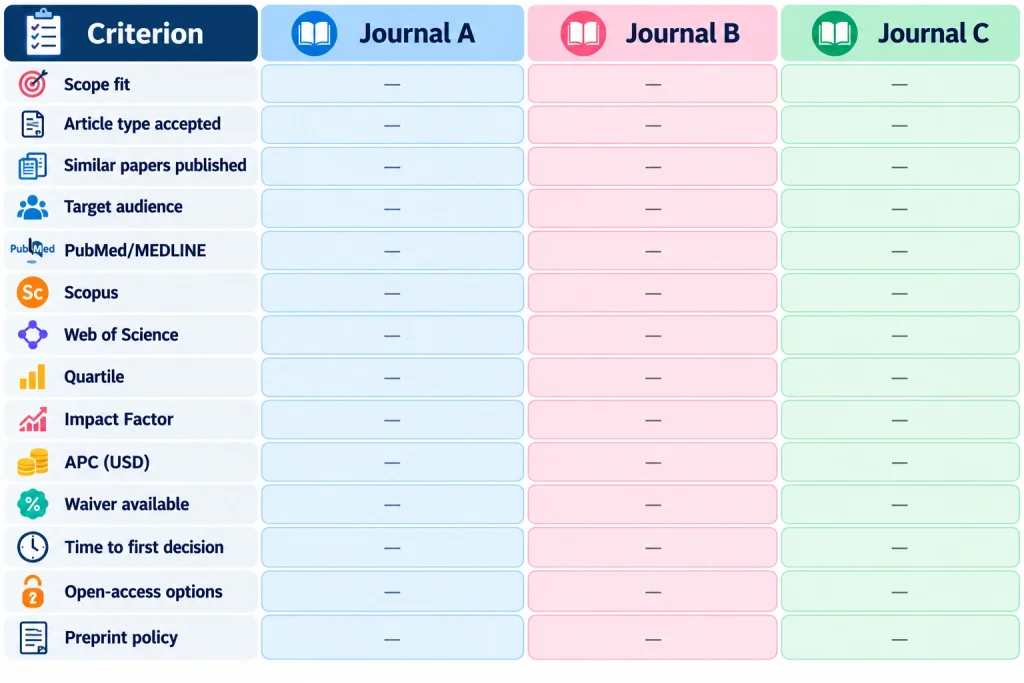
Journal Selection Worksheet: Compare 3-5 Journals
The table below shows your selected journals. Enter data in one column at a time. Weak spots are evident when all data is entered in one table.
What to Do if Your Manuscript Is Rejected
Rejection is part of every research career, and here are some tips on how best to cope and move on.
Read the Editor’s Decision Letter
Reading reviewer comments are optional, but read the editor’s letter in their entirety before making a decision.
Figure Out Why It Was Rejected
Was the main reason it was rejected due to the fit of your methods to the research question, or was the main reason it was rejected due to the reporting of your results? Answering this will help point you in the right direction of what needs to be changed to address the journal’s concerns before submission.
Revise Manuscript
Which changes are reasonable and how to frame them without conceding ground you do not need to give up is covered elsewhere: responding to reviewer comments is the part of the process nobody teaches before you need it.
Submit to Your Backup Journal
Move on to your next best journal and edit to match its author guidelines.
Avoid Simultaneous Submissions
Do not submit to multiple journals at the same time. This is unethical.
COMMON JOURNAL SELECTION ERRORS
- Picking a journal based on Impact Factor alone
- Not reviewing the aims and scope
- Overlooking accepted article types
- Blindly accepting indexing claims
- Finding out about article processing charges (APCs) after acceptance
- Submitting to journals far beyond the scope of the study
- Failing to check recent issues
- Failing to review author guidelines
- Accepting invitations to submit from unknown journals
- Submitting to multiple journals at the same time
What is the best journal for medical research?
No journal is best for all medical research. The best choice for a given research paper depends on the research question and study design. It also depends on how well the article type matches the journal scope and readership. Verified indexing, reasonable fees and charges, and expected processing times also play a role. A good fit, specialized journal is often the best choice compared to a general, well-known journal.
Frequently Asked Questions
Q1. How do I choose a journal for a medical research paper?
Start with your topic, study design, and article type. Find journals that recently published similar studies, confirm their scope and indexing, and then compare fees and timelines. If the manuscript itself still needs work before it goes anywhere, how to publish a medical research paper covers the full sequence from finished study to submitted file.
Q2. What factors should I consider when selecting a medical journal?
Consider scope, accepted article types, audience, recent papers, verified indexing, metrics, fees, review speed, and submission rules such as reporting guidelines and AI policies.
Q3. Is a Q1 journal always better?
No. Q1 means the journal ranks in the top quarter of its subject category. It is only a better choice if your paper fits its scope, readers, and standards.
Q4. What impact factor is good for a medical journal?
There is no single number. Impact factors vary widely between specialties, so compare journals within your own field rather than using a fixed cutoff.
Q5. How can I check if a journal is PubMed indexed?
Search the journal’s title or ISSN in the NLM Catalog. It shows whether the journal is currently indexed for MEDLINE or has content in PubMed Central.
Q6. Is Scopus indexing enough to trust a journal?
It is a good sign but not proof on its own. Also review the editorial board, peer-review process, fees, and recent articles.
Q7. How can I identify a predatory journal?
Look for guaranteed acceptance, unverifiable indexing, made-up metrics, hidden fees, and aggressive emails. The Think. Check. Submit. checklist helps you screen unfamiliar journals.
Q8. Can AI help me find a journal?
Yes, AI tools can produce a quick starting list. Check every suggestion against the journal’s website, the indexing databases, and its recent articles.
Final Thoughts
Choosing a journal well takes some time, but most of the work is simple checking: scope, article type, recent papers, indexing, and fees, in roughly that order. Researchers who do this before submitting tend to see fewer desk rejections and reach publication sooner.
Publication Support
Most desk rejections are a journal selection problem, not a manuscript problem.
Scope mismatch, wrong article type, unverified indexing claims, APCs discovered after acceptance. Each one is avoidable with thirty minutes of checking. Each one is also the kind of thing that’s obvious to someone who has been through the submission process more than once.
The American Academy of Research & Academics works with medical students, residents and early career researchers at every stage of publication, from developing a research question through manuscript preparation, journal selection and submission. If you would like help deciding where your paper goes next, this is where to start.
Disclaimer:
Articles published by American Academy of Research & Academics are prepared by our team using information from direct experience, publicly available resources, and educational references. AI tools may be used to assist with drafting, proofreading, and formatting; however, all content undergoes review and approval before publication.
The information provided is intended for educational purposes only. Requirements, policies, and processes may change over time. Readers should consult official sources for the most current information.