
Introduction
A few months after you submit your paper, the journal finally emails you back. You open it hoping for an acceptance. Instead, the editor has asked you to “revise and resubmit,” and there are three pages of reviewer comments below the decision. After all the work you put into the paper, that can feel discouraging.
But this is how peer review usually goes. Most researchers get revision requests, even those who have published many papers. If the editor thought your paper had no chance, they would most likely have rejected it. Asking for revisions means they think the work can be published once some problems are fixed. For an overview of where revisions fit into the publication process, see our guide on how to publish a medical research paper.
In this article, we’ll go over how to respond to reviewer comments in a clear and professional way. We’ll cover reading and sorting the comments, making changes to your manuscript, writing a point-by-point response, and handling comments you don’t agree with. You’ll also find sample replies and a short response letter that you can use as a template.
What Are Reviewer Comments?
When a journal receives your manuscript, the editor sends it to two or three experts in your field, called reviewers. They read the paper closely and write notes on what is missing, unclear, or wrong. These notes are your reviewer comments. Reviewers usually do this work for free, alongside their own research. The editor reads their reports and uses them to decide what happens to your paper.
Editorial comments come from the editor, not the reviewers. They are usually short. In them, the editor may tell you which reviewer points matter most, when the revision is due, and how to format your changes.
Reviewer comments are often split into major and minor comments. Major comments are about bigger issues, such as the study design, methods, statistical analysis, or whether your conclusions match your results. Minor comments are about smaller fixes, such as grammar, typos, missing references, or figure labels. If a reviewer questions your choice of analysis, our guide to choosing the right statistical test for medical research can help you revisit the reasoning behind your approach.
Keep in mind that a “revise and resubmit” decision does not guarantee acceptance. The editor will review your revised paper and may send it back to the same reviewers. How well you respond to their comments plays a big role in the final decision.
What Should You Do After Receiving Reviewer Comments?
Before you start writing any replies, spend some time planning. It will make the revision go faster.
- Read the editor’s decision letter first. Note the deadline for resubmission and any instructions on how to show your changes.
- Read all the reviewer comments from start to finish. Don’t fix anything yet. Try to understand the main concerns first. You may notice that two reviewers are asking for the same thing in different words.
- Take a day if you feel upset or defensive. Many researchers feel this way when they first read critical comments. Remember that the comments are about the manuscript and not about you. They usually seem more reasonable when you read them again the next day.
- Sort the comments into groups. This helps you plan the work and divide it among your coauthors. For example, you could group them into:
- Major revisions
- Minor revisions
- Methods or statistics
- Writing and clarity
- References
- Optional suggestions
- Make a revision checklist. You can use a spreadsheet with three columns: the comment, what you plan to do, and who will do it. Mark each comment as done when it’s finished so you don’t miss anything.
American Academy of Research & Academics
Reviewer questioning your methods? Understand the decisions behind them.
Strengthen your understanding of study design, sampling, bias, and confounding with AARA’s Basic Research Methodology course.
How to Respond to Reviewer Comments Step by Step
You will submit two documents: your revised manuscript and a response letter. The response letter explains what you changed in reply to each comment. Follow the steps below to prepare both.
1. Start With a Professional Response Letter
At the top of your response to reviewers letter, thank the editor and reviewers for their time. Then add a sentence or two summarizing the changes. Don’t make this part long. Here is an example:
“We sincerely thank the editor and reviewers for their careful evaluation of our manuscript and constructive comments. We have addressed each comment and revised the manuscript accordingly.”
2. Respond to Every Reviewer Comment
Every comment needs a reply, including small ones about grammar or reference style. If you decide not to make a change, say so and explain why. If you leave a comment without a reply, the reviewer may think you missed it or ignored it on purpose.
3. Use a Point-by-Point Response
Copy each reviewer comment into your letter exactly as it was written. Then write your reply directly below it. Many authors use this three-part format:
Reviewer Comment 1: “The sample size seems too small to support the conclusions drawn in the Discussion.” (Copy the reviewer’s exact words here.)
Author Response: Thank you for this important comment. We agree that our sample size limits how far the findings can be generalized. We have softened the conclusions and added this point to the Limitations section.
Changes in Manuscript: We revised the Discussion on Page 11, Lines 250 to 258, and the Limitations section on Page 13, Lines 301 to 305.
With this format, reviewers can check each change quickly without searching through the whole manuscript. Also check whether the journal asks you to use tracked changes or highlight your edits in the revised file. For a comment about sample size, revisit the assumptions documented when you planned the study. Our guide to sample size calculation for clinical research explains the inputs and reporting details behind that justification.
4. Explain Exactly What You Changed
“Done” and “Corrected as suggested” are two of the weakest replies you can give. They don’t tell the reviewer what you did or where to look. Compare these:
- Weak: “Corrected.”
- Better: “We have corrected the sample size in Table 2 from 112 to 121 so it matches the Results section (Page 8, Line 204).”
The second reply takes a few extra seconds to write and saves the reviewer a lot of guessing.
5. Be Polite Even When You Disagree
You’re allowed to say no to a suggestion. You can’t say no without a reason. Base your answer on science, not feelings, and keep the tone friendly even if the comment came across as harsh.
6. Cross-Check the Revised Manuscript
Before you hit submit, put the response letter and the manuscript side by side. Go through every promise in the letter and find it in the paper. It’s surprisingly easy to write “we have added this to the Discussion” and then forget to add it. Recheck page and line numbers too, because they move around as you edit. Check the abstract as well, especially if you changed any results or conclusions. Our guide on how to write a medical research abstract can help you keep that summary clear and consistent with the revised paper.
How to Respond to Reviewer Comments: Examples
How you word a reply depends on what the reviewer asked. The table below covers the situations you’ll run into most often, with a sample author response for each.
| Situation | Sample Author Response |
| You agree with the reviewer | “Thank you for this valuable suggestion. We agree and have revised the Discussion to compare our findings with recent studies (Page 12, Lines 280 to 295).” |
| Reviewer asks for clarification | “We appreciate this comment. We have clarified how patients were recruited in the Methods section (Page 5, Lines 98 to 104).” |
| Reviewer identifies an error | “Thank you for catching this error. We have corrected the percentage in Table 3 and rechecked the other values in the table.” |
| You partially agree | “We agree with the reviewer that the follow-up period was short. However, extending follow-up is not possible for this study, so we have added this point to the Limitations section.” |
| You disagree | “We appreciate the reviewer’s suggestion. However, we respectfully believe that [your reason], as supported by [evidence or reference].” |
| Requested analysis cannot be performed | “We appreciate this suggestion. Unfortunately, we could not perform this analysis because data on smoking status were not collected. We have noted this as a limitation.” |
| Reviewer requests additional references | “Thank you for this suggestion. We have reviewed the recommended literature and added two relevant studies to the Introduction (References 14 and 15).” |
One tip: Treat these as starting points, not lines to copy and paste. A reply only works when it points to a real change or gives a real reason. Reviewers read plenty of “Thank you for this valuable suggestion” with nothing behind it, and it rarely wins them over.
American Academy of Research & Academics
Statistical feedback is easier to address when you understand the analysis.
Build practical skills in data analysis and interpretation with AARA’s Biostatistics course, and bring a stronger foundation to your next manuscript revision.
Sample Response to Reviewer Comments Letter
Below is a short sample response to reviewers letter you can adapt. Swap the bracketed parts for your own details.
Dear Editor and Reviewers,
Thank you for your thoughtful and constructive comments on our manuscript, “[Manuscript Title].” We have carefully considered each comment and revised the manuscript accordingly. Our point-by-point responses are provided below, and all changes are highlighted in the revised manuscript.
Reviewer #1
Comment 1: The inclusion criteria need further clarification.
Response: Thank you for highlighting this issue. We agree that the eligibility criteria were not clear enough. We have revised the Methods section to state that we included adults aged 18 to 65 with confirmed type 2 diabetes and excluded patients on dialysis.
Change: Page 5, Lines 110 to 118.
Repeat this pattern for every comment from every reviewer. Keep in mind that journals don’t all want the same format. Some ask for a table, some want a separate file, and some have you paste replies straight into the online submission system. When in doubt, go with whatever the editor asked for.
How to Disagree With a Reviewer Professionally
It’s fine to disagree with a reviewer. Reviewers are experts, but they can still misread a method or ask for something outside your study’s scope. What matters is that you back up your position. A simple way to structure your reply is to thank them, explain your reason, show your evidence, and state what you decided. Before defending a methodological choice, consider whether the comment identifies a genuine weakness. Our guide to why research papers get rejected because of poor methodology explains the concerns reviewers look for in study design and analysis.
“We appreciate the reviewer’s suggestion regarding X. However, we respectfully chose not to make this change because [scientific or methodological reason]. To clarify this point, we have now added…”
Good support for your reasoning can come from:
- Your study design or methodology
- Limits of the data you collected
- Published references
- The journal’s requirements
- The scope of your study
Notice how the example ends. You didn’t make the requested change, but you still added a line to clear up the confusion. That small step often settles the issue. Whether your journal calls it a response or a rebuttal letter, the rule is the same: stay respectful and let the evidence speak for you. If you need additional references to support your reasoning, our guide on how to use PubMed effectively for medical research walks you through finding relevant papers with focused keywords, MeSH terms, and Boolean operators.
Common Mistakes When Responding to Reviewers
Editors see the same slip-ups again and again. Some begin before the response letter, with unclear writing, weak literature searches, or gaps in statistical understanding. Our guide to common research mistakes IMGs make covers these broader issues. When preparing your response to reviewers, watch out for these:
- Skipping a comment, even a minor one
- Replying in an emotional or defensive tone
- Writing “done” without saying what you changed
- Making changes without saying where they are
- Agreeing with a reviewer, then forgetting to revise the manuscript
- Disagreeing without a scientific reason
- Writing long replies that bury the main point
- Missing the revision deadline
- Uploading the wrong version of the manuscript
- Ignoring the journal’s revision instructions
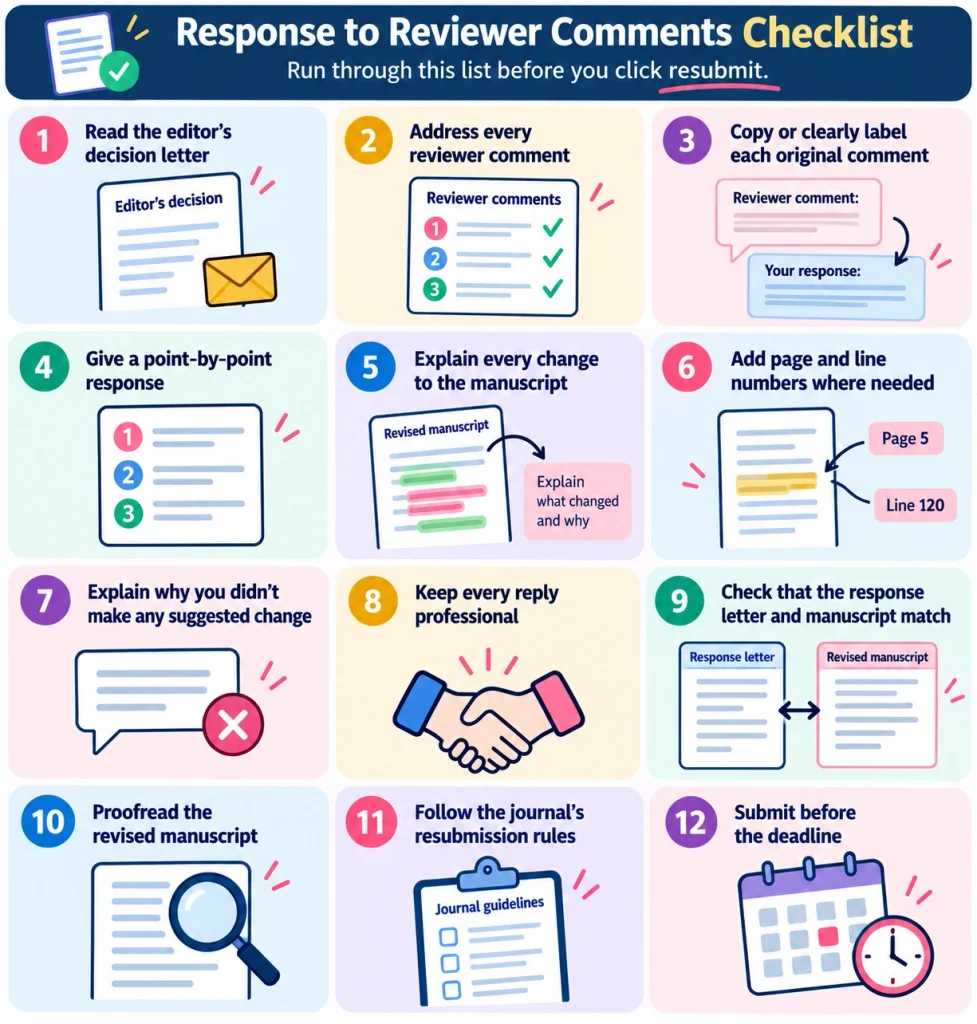
Response to Reviewer Comments Checklist
Run through this list before you click resubmit.
Frequently Asked Questions About Reviewer Comments
Q1. Do I have to accept every reviewer suggestion?
No. If you have a solid scientific or methodological reason, you can politely decline a suggestion. Just explain that reason clearly in your reply.
Q2. How do you start a response to reviewer comments?
Thank the editor and reviewers for their time. Then say in one sentence that you’ve addressed their comments and revised the manuscript. Keep the opening brief.
Q3. Should I respond to every reviewer comment?
Yes, every single one. If you didn’t change the manuscript for a particular comment, explain why in your reply.
Q4. Can I disagree with a journal reviewer?
Yes, and authors do it often. Stay polite and back up your point with your study design, your data, or published references.
Q5. What is a point-by-point response to reviewers?
It’s a document that lists each reviewer comment, followed by your reply and, where relevant, the exact change you made in the manuscript, with page and line numbers.
Q6. What is the difference between a response letter and a rebuttal letter?
Journals use these terms in different ways. A response letter usually explains how you handled each comment. A rebuttal letter tends to focus on challenging specific criticisms, and sometimes the word refers to an appeal after a rejection.
Q7. How long should a response to reviewers be?
There’s no fixed length. A paper with 30 comments will need a longer letter than one with five. Answer each comment fully, then stop, and don’t repeat the same explanation in several places.
Final Thoughts
Responding to reviewer comments isn’t complicated once you break it into steps. Read the feedback, sort it, revise the paper, reply point by point, explain where you disagree, proofread, and resubmit. Your first response letter will probably take a while. By the third or fourth, you’ll have your own system.
American Academy of Research & Academics
Turn reviewer feedback into a plan for what to learn next.
Not sure which research skills to strengthen? Tell the AARA team about your experience and goals, and ask which course or research program fits your next step.
Want help with your next manuscript or revision? The American Academy of Research and Academics (AARA) offers training and resources for doctors, IMGs, and early-career researchers who want to get published. Check out AARA’s courses and take the next step in your research journey.
Disclaimer:
Articles published by American Academy of Research & Academics are prepared by our team using information from direct experience, publicly available resources, and educational references. AI tools may be used to assist with drafting, proofreading, and formatting; however, all content undergoes review and approval before publication.
The information provided is intended for educational purposes only. Requirements, policies, and processes may change over time. Readers should consult official sources for the most current information.