
Research usually starts with something small. A patient who didn’t respond the way the textbook said they would, or a paper you read on call that seemed to stop just short of the interesting question. The trouble begins when you try to write it down, because what lands on the page is almost always a topic rather than a question, and topics can’t be studied.
Take “does exercise help blood pressure?” There’s no sensible way to search for it, no study design that follows from it, and no version of an answer that comes out as a clean yes or no. PICO is the tool that closes that gap for clinical questions, and it takes about ten minutes to learn.
This guide covers what the four letters mean, how to build a question step by step, worked examples from treatment, prevention, diagnostic and education research, whether PICO holds up in qualitative work, how it differs from PEO, what PICOM refers to, and which other frameworks are worth knowing.
What is PICO in Research?
PICO breaks a clinical question into four parts: the people you’re studying, the thing you’re testing, whatever you’re testing it against, and the result you plan to measure.
| Element | Meaning | Question to Ask |
| P | Population, Patient, or Problem | Who is the patient or population? |
| I | Intervention | What intervention are you considering? |
| C | Comparison | What is it being compared with? |
| O | Outcome | What outcome are you measuring? |
Going back to the exercise question:
Broad idea: Does exercise help patients with hypertension?
PICO question: In adults with hypertension (P), does regular aerobic exercise (I), compared with usual care (C), reduce systolic blood pressure (O)?
The underlying idea hasn’t changed at all. What’s changed is that the second version tells you who to recruit, what to ask them to do, which group they’ll be measured against, and what number goes in your results table. You could take it to a supervisor and have a real conversation about whether it’s feasible. The first version gives you nothing to discuss.
Why Use the PICO Framework in Research?
PICO isn’t just about phrasing things neatly. Writing out the four elements forces you to make decisions you’d otherwise put off until they turn into problems halfway through your project.
Once you write down your population, you know who’s eligible and who isn’t, so your inclusion and exclusion criteria are basically drafted. Once you write down your outcome, you know what you’re measuring, which your sample size calculation depends on.
You also get your search terms almost for free. Each element gives you keywords to combine in PubMed or Embase, and searches built this way come back with studies you can actually use instead of two thousand loosely related hits. Turning those elements into an actual search string takes a bit of technique. Using PubMed effectively for medical research covers MeSH terms, Boolean operators and field tags.
There’s a design benefit too. A question with a real intervention and a real comparator points you toward a trial or a comparative study. If your question has no comparator in it anywhere, that’s usually a sign you’re doing a different kind of study than you thought.
Which design your question implies is worth checking before you commit. Cross sectional study design in medical research and what is quantitative research both cover what each design can and cannot answer.
For IMGs and first-time researchers, this is the part that matters. PICO is what gets you from “I have a research idea” to “I have a question I can investigate.”
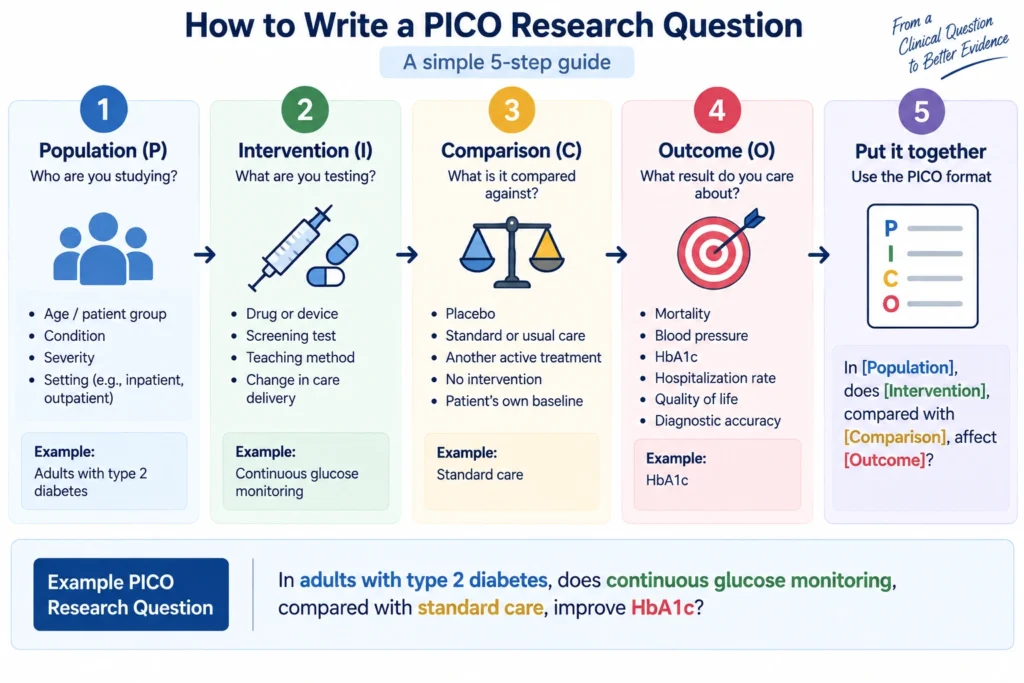
How to Write a PICO Research Question Step by Step
Step 1: Define your population
Who exactly are you studying? Be stricter here than feels necessary. A vague population makes every other element harder to pin down.
Think about age, the condition, how severe it is, and where these patients are being seen.
Example: Adults with type 2 diabetes.
Step 2: Identify the intervention
What are you actually testing? It doesn’t have to be a drug. A device counts. So does a screening test, a teaching method, or a change in how care is delivered.
Example: Continuous glucose monitoring.
Step 3: Choose the comparison
What are you comparing it against? Usually one of these:
- Placebo
- Standard or usual care
- Another active treatment
- No intervention
- The patient’s own baseline
Choose carefully, because the comparator changes what your result means. Beating a placebo and beating current standard care are two very different claims, and reviewers will notice which one you made.
Step 4: Define the outcome
What result do you care about, and can you record it? Those two questions go together.
Examples: Mortality, systolic blood pressure, HbA1c, hospitalization rate, quality of life scores, diagnostic accuracy.
Your outcome type also decides how it gets analysed. Which statistical test to use in medical research covers why a continuous outcome and a binary one lead to completely different analyses.
Step 5: Put it together
The formula:
In [Population], does [Intervention], compared with [Comparison], affect [Outcome]?
Using the diabetes example: In adults with type 2 diabetes, does continuous glucose monitoring, compared with fingerstick self-monitoring, improve HbA1c at six months?
Here’s a quick test. Read your question out loud and try to picture the study that would answer it. If you can’t see it, one of the four elements is still too vague. Go back and find which one.
Research Methodology
A good question decides the design. Most people discover that in reverse.
Population becomes your eligibility criteria. Outcome drives your sample size. Comparator points you at a study design. Get those four settled properly and the next six months of work follow from them instead of fighting you.
PICO Research Question Examples
Examples tend to make this click faster than definitions do, so here are four from different corners of research.
Example 1: Treatment
- P: Adults with hypertension
- I: ACE inhibitors
- C: Calcium channel blockers
- O: Blood pressure control
Question: In adults with hypertension, are ACE inhibitors more effective than calcium channel blockers for controlling blood pressure?
Example 2: Prevention
- P: Adults at high risk of cardiovascular disease
- I: Structured lifestyle intervention
- C: Usual care
- O: Cardiovascular events
Question: In adults at high risk of cardiovascular disease, does a structured lifestyle intervention, compared with usual care, reduce cardiovascular events?
Example 3: Diagnostic research
- P: Adults presenting with suspected deep vein thrombosis
- I: D-dimer testing followed by ultrasound
- C: Ultrasound alone
- O: Diagnostic accuracy
Question: In adults with suspected DVT, does D-dimer testing followed by ultrasound, compared with ultrasound alone, improve diagnostic accuracy?
Diagnostic questions measure accuracy rather than effect, which changes what you report. P value versus confidence interval covers how to present that kind of estimate honestly.
Example 4: Medical education
- P: Medical students
- I: Simulation-based teaching
- C: Traditional classroom teaching
- O: Clinical skills performance
Question: Among medical students, does simulation-based teaching, compared with traditional teaching, improve clinical skills performance?
Look at that last one again. No patients, no drug, no clinical outcome. PICO still works, because there’s a defined group, something being done to them, something to compare it with, and something you can score.
One tip before you start: your question should be narrow enough to study, but not so narrow that there’s no existing literature to build on. If a search returns three papers, you’ve probably gone too far.
Can You Use PICO for Qualitative Research?
Not really, and this catches out a lot of beginners.
PICO quietly assumes two things. That something is being done to a group of people, and that the result can be counted. Qualitative research often has neither. If you want to understand how patients experience a new diagnosis, there’s no intervention to assign and no number at the end of it. Push that question into PICO anyway and you end up with an empty “C” and an “O” that isn’t an outcome in any real sense.
Which is why qualitative researchers use different frameworks. PEO is one of the most common.
| Element | Meaning |
| P | Population |
| E | Exposure |
| O | Outcome |
The “O” here isn’t a measurement. It stands for a lived experience, a perception, a barrier, something people describe rather than something you record on a chart.
Example:
- P: International medical graduates
- E: Applying for US residency
- O: Perceptions and barriers encountered during the application process
You could answer that with interviews or focus groups. And notice it never needed a comparison group at all.
PICO vs PEO: Which Framework Should You Use?
| Framework | Best suited for | Typical question |
| PICO | Clinical and intervention questions | Does X improve Y? |
| PEO | Exposure and experience questions | What is the experience of X? |
| PICOT | Clinical questions with a time element | Does X affect Y over Z months? |
| PICo | Qualitative questions | What are the experiences of X in a given context? |
The rule is short enough to remember. PICO when your question is about an intervention and something measurable. PEO or another qualitative framework when it’s about experiences, perceptions, or exposures you aren’t controlling.
Still unsure? Ask whether your study assigns or compares anything at all. If the answer is no, PICO probably isn’t your framework.
The same choice appears one level up, when you decide what kind of review to write. Systematic review versus narrative review covers how the question type determines the method, not the other way round.
Systematic Review
In a systematic review, your PICO is not a draft. It is a commitment.
It goes on the PROSPERO form before you screen a single study, it becomes your eligibility criteria, and it generates the search string a reviewer will try to rerun. Changing it later is an amendment you have to declare. Learn to get it right the first time.
What Is PICOM in Research?
You’ll run into PICOM occasionally, usually in course material or a methods paper. It’s described as an extension of PICO, and the “M” is most often given as method or methodology. Most often, but not always. The definition shifts between sources and between disciplines.
That inconsistency is the reason to be careful with it. PICOM isn’t established the way PICO, PICOT, and PEO are. If you do use it, spell out your version in the methods section so nobody has to guess what your extra element means. For anyone new to research, sticking with the standard frameworks is the easier path.
Common Mistakes When Writing a PICO Question
Population too broad: “Patients with cancer” covers dozens of diseases with different treatments and different survival. Try “adults with newly diagnosed non-small-cell lung cancer.”
Vague intervention: “Treatment” tells your reader nothing at all. Name it. “Adjuvant chemotherapy.”
An outcome you can’t measure: “Better health” isn’t recordable. “Twelve-month hospitalization rate” is.
No comparison: Some questions genuinely don’t need a comparator. But when one is relevant and you leave it out, the question gets weaker, and the study gets harder to design. Vague questions are one of the most common reasons a first project stalls. Research mistakes IMGs make and how to avoid them covers the wider set, from design through to authorship.
Forcing everything into PICO: It’s a tool, not a rule. Plenty of good research questions don’t fit it, and that’s not a problem with the question.
PICO and Other Research Question Frameworks
PICO is the famous one, but it isn’t the only option.
- PICO for intervention-focused clinical questions.
- PICOT adds a time frame, which matters when your outcome depends on how long you follow people.
- PEO covers population, exposure, and outcome. Good for observational and qualitative work.
- PICo covers population, phenomenon of interest, and context, and shows up often in qualitative reviews.
There are others, built for other designs. What you pick should follow your methodology, not the acronym you happened to learn first.
Frequently Asked Questions About PICO
Q1. What does PICO stand for in research?
Population, Intervention, Comparison, and Outcome.
Q2. What is a PICO question?
A focused research question built around a specific population, an intervention, a comparison, and a measurable outcome.
Q3. Is PICO only used for clinical research?
No. It’s most common in clinical and evidence-based research, but it works anywhere there’s an intervention and an outcome. Medical education research uses it regularly. Chart reviews are another common case. How to do a retrospective chart review covers how to frame a PICO question when the data already exist and nothing is being assigned.
Q4. Can PICO be used for qualitative research?
Not comfortably. PEO or PICo are usually better suited to questions about experiences and perceptions.
Q5. What is the difference between PICO and PEO?
PICO has an intervention and a comparison built into it. PEO focuses on a population, an exposure or experience, and an outcome, and doesn’t require a comparator.
Q6. Does every research question need PICO?
No. It’s one framework among several, and the right one depends on your design and your question.
Final Takeaway
Start with the question, then pick the framework. Not the other way around.
PICO earns its place when you’re asking whether an intervention changes an outcome in a defined group of people. If your question is really about experiences or exposures, PEO or a qualitative framework will serve you better. That decision rule is worth more than memorizing four letters.
Ready to turn your research idea into a real study?
Writing a focused question is step one. Designing the study, running the analysis, and getting it published are the steps that follow, and they’re where most beginners stall.
The American Academy of Research and Academics (AARA) works with young researchers and international medical graduates through that whole process, from framing a research question to systematic reviews & meta-analysis, and publication. If you’d rather have structured guidance than work it out alone, get in touch with AARA and start building your research portfolio.
Research Courses
Every stage after this one has its own set of decisions.
Which design your question implies. How many participants it needs. Which test fits the outcome you chose. Whether the evidence already exists and should be synthesised rather than collected again. None of those are obvious, and each one is a place where a first project quietly goes wrong.
AARA runs separate courses for each: research methodology, biostatistics, narrative review, systematic review and meta-analysis. Start wherever you are stuck rather than at the beginning.
Disclaimer:
Articles published by American Academy of Research & Academics are prepared by our team using information from direct experience, publicly available resources, and educational references. AI tools may be used to assist with drafting, proofreading, and formatting; however, all content undergoes review and approval before publication.
The information provided is intended for educational purposes only. Requirements, policies, and processes may change over time. Readers should consult official sources for the most current information.