If you are a medical student or a graduate outside the United States, and are wondering where to start research and what type of research you can do that not only advances your knowledge but also helps you secure a residency spot during the match, At American Academy of Research & Academics this guide is for you.
Introduction
Narrative reviews are basically scholarly stories that synthesize existing research on a topic to tell a clear, compelling picture of what we know. For IMGs, conducting large-scale original studies can feel impossible due to the common hurdles of tight budgets, scarce mentors, demanding schedules, and limited lab access. But here’s the good news, crafting a sharp narrative review is a brilliant way to build your academic profile. It’s a strategic, accessible path to making a meaningful impact. This article will show you exactly why mastering the narrative review is one of the smartest moves an IMG can make.
Why Research is not a mere formality for IMGs
For IMGs navigating the path to residency or fellowship, the research landscape often feels complex. The barriers are well known: IMGs have limited access to institutional research infrastructure, restrictive visas make it difficult to secure research opportunities in the US, and the absence of a guiding mentor who can lead them through the meticulous research journey. Yet, there is immense pressure to publish for career advancement, making every academic effort a high-stakes challenge. Which is why choosing your research format strategically isn’t simply an academic exercise; it’s a skill you’ll need throughout your career. You want a project that uses your clinical insight and really doesn’t need a lab bench or tons of grant money. Choosing the format that fits you and is within your ability will change impossible into possible, feasible into attainable, and something they want from applicants.
What Exactly is a Narrative Review?
Think of a narrative review as the big-picture storyteller of academic research. Unlike a systematic review, which is like a strict scientific audit with rigid rules for every study it includes, a narrative review is more flexible. It’s all about taking a broad topic, like new trends in medical education or a tricky clinical debate and weaving the existing literature into a clear, logical story. You get to synthesise ideas, connect different concepts, and highlight what matters. This format is incredibly useful when you’re dealing with an emerging field where the research is still messy, or when you’re exploring big themes, policy questions, or theoretical discussions. It’s about making sense of the conversation, not just counting the participants.
| Feature | Narrative Review | Systematic Review |
|---|---|---|
| Goal | Broad overview and expert insight | Answer a specific research question |
| Scope | Broad, flexible | Narrow, focused |
| Search Method | Flexible, not always reproducible | Structured, comprehensive, reproducible |
| Study Selection | More subjective | Strict, predefined criteria |
| Time & Resources | Lower | Higher |
| Methodological Rigor | Moderate | High |
| Risk of Bias | Higher | Lower |
| Best For | Emerging topics, conceptual discussion | Evidence-based decisions, guidelines |
| Suitability for IMGs | More accessible and feasible | More demanding and resource-intensive |
Why Narrative Reviews Are the Smart Choice for IMGs?
Let’s break down why narrative reviews aren’t just a compromise, but often the smartest strategic move for an IMG. The advantages hit directly on the common barriers we face.
A. Lower Resource Requirements
Forget needing a lab, special software, or funding for data collection. The core tools here are your brain and access to a good academic library database, which is often available remotely or through institutional affiliations you might already have. All you truly need is a computer, an internet connection, and the diligence to track down published literature. You can conduct the literature review and write the manuscript remotely, making it an ideal research approach for IMGs.
B. Feasible Without Institutional Backing
This is huge. You don’t need to be embedded in a major university’s research department. A narrative review can be undertaken independently or with minimal, remote mentorship. It’s perfectly suited for IMGs currently working in community hospitals, in between positions, or even preparing from abroad.
C. Faster Path to Publication
Let’s be real, time is a luxury we often don’t have. A well-done narrative review can be finished and sent in just a few months, compared to the multi-year timeline of original research or the long, protocol-bound process of a systematic review. This level of efficiency is very important when you need to make your CV or residency application stronger in a short amount of time.
D. Builds Critical Academic Skills
Writing a narrative review helps you learn core academic skills that will help you synthesise complex research like systematic reviews and draft protocols of original studies. You’ll get better at putting together a lot of different pieces of writing, finding important themes and controversies, and writing a compelling story. These are all skills that you can use in future research, fellowship applications, and clinical practice.
E. High Visibility and Citation Potential
Don’t mistake “feasible” for “less impactful.” A thoughtful narrative review that clarifies a confusing topic or proposes a new framework can have tremendous influence. These papers often become go-to references for clinicians, educators, and policymakers precisely because they provide a synthesised, readable overview. This leads to strong readership and solid citation potential, building your academic reputation in a very visible way.
Writing A Narrative Review Has Career Benefits for IMGs
So, let’s talk about what all this work really means for your career as an IMG. A published narrative review does prove you can think like a scholar, and that’s one of its most powerful benefits. For Residency and fellowship programs, this serves as a stand-out signal among hundreds of competitive applications. It shows you’ve taken the initiative to deeply understand a specific field, moving from just learning facts to synthesising them and forming your own perspective.
But the benefits go way beyond a line on your CV. The process naturally helps you build a professional network. You’ll be reading and citing the work of leaders in your field, and reaching out to a potential mentor to discuss your idea becomes a natural, respected step. Most importantly, it builds a foundational skill set and helps you learn to conduct more advanced research projects.
Basically, it is a very good starting point for your research journey that helps you synthesise systematic reviews and meta-analyses. Use these as learning tools that help you learn skills you will be honing for the future.
Common Misconceptions About Narrative Reviews
There are some very common myths about narrative reviews. The biggest one is that they’re somehow a “lesser” form of research than a systematic review, or that, because their method is more flexible, they must be easier and less respected. People sometimes think journals are only interested in hard, original data or studies with complex methodologies. Well, the truth is a bit different. It has to be kept in mind that the quality of any review, whether narrative or systematic, depends entirely on its rigour, its logical structure, and the depth of the knowledge. A shallow, poorly organised review is weak, but a masterful synthesis that clarifies a complex field is incredibly valuable. In fact, top-tier journals regularly publish authoritative narrative reviews because they shape clinical thinking, education, and policy in ways a narrow systematic review cannot. Their unique value is in telling the story, not just tallying the data.
If anyone tries to demotivate you by saying” narrative reviews are not important” tell them that a high-quality narrative review is way more impactful than a weak systematic review.
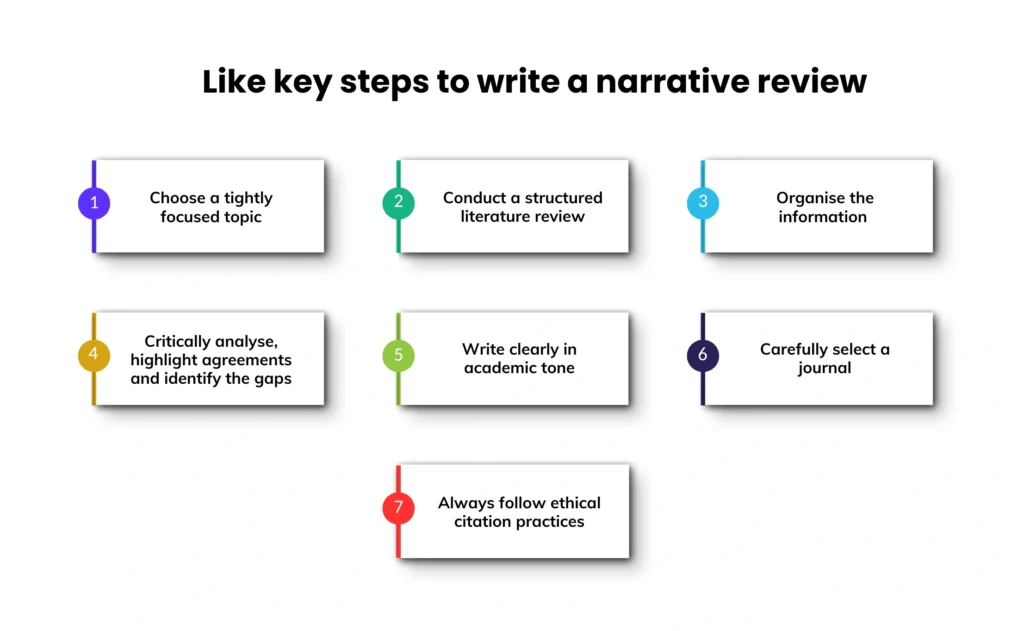
Key Steps to Write a Strong Narrative Review
- Starting a strong narrative review begins with choosing a tightly focused topic which is relevant to your field, but not so broad that it becomes overwhelming.
- Once you have your question, conduct a structured literature search across multiple databases.
- As you read, organise the information around key themes or evolving concepts, not just chronologically.
- Your real job is to critically analyse, highlighting agreements, controversies, and gaps in the existing knowledge.
- Write clearly and in an academic tone, ensuring each section flows logically into the next.
- When you’re done, carefully select a journal that publishes similar narrative reviews.
- Always follow ethical citation practices to give proper credit.
Limitations of a Narrative Review
Despite their importance to IMGs and young researchers, narrative reviews have limitations. They have flexibility as a strength, but also a vulnerability. Without a strict, pre-defined methodology, there’s a risk of selection bias, where you might unintentionally favour literature that supports your perspective. That’s why you have to be responsible when writing a narrative review. You must commit to transparency about how you searched for and selected studies. To maintain the highest level of academic honesty, you should fairly represent opposing views and cite your sources carefully. Most importantly, never make your conclusions too strong. Clearly stating that it is an expert synthesis and not the last word is important for its credibility.
Conclusion
Let’s be clear, for an IMG, a narrative review isn’t a plan B but it’s a brilliant plan A. It’s the strategic, accessible gateway into the world of research that so many of us need. Start by viewing this not just as a single publication, but as the foundation for your entire scholarly identity. The skills you build and the credibility you earn will directly support future projects, from case reports to original studies.
By contributing a clear, thoughtful synthesis, you’re not just boosting your own career; rather, you’re joining a global conversation in advancing medicine.
If you want to learn more about narrative reviews and synthesise a meaningful study that contributes to the world of medicine. Feel free to Enroll in Our Narrative Review Module.