
You have a question about your clinical problems and want it to be answered. Perhaps it’s like, “Does a new drug to treat blood pressure work better than the one that my patients are already taking? This is a good question to start, but to take it to the next level you will need to develop a trial design that people will feel comfortable gambling their life on.
This is the clinical research type randomized controlled trial. It is a description of enrolment, allocation and interventions provided for participants. It gives information on what the endpoints will be, how they will be measured. All of this must be determined prior to the first participant signing up.
What you will see below is a 10 step explanation of how to design and do a randomized controlled trial. We will continue to use our blood pressure example throughout.
What is an RCT (Randomized Controlled Trial)?
The experimental study in which participants are allocated to some groups and then a treatment is administered to one group, but not to the other, is termed an RCT. The effects on the treated group is then compared to the group which was not exposed to the treatment.
In our example:
A new type of blood-pressure medicine has been created.A new drug to treat hypertension has been produced.
The participants (adults only) who have hypertension are divided into two groups:
After 12 weeks, the first group (the treatment group) takes the new drug, and their blood pressure is taken to determine the effectiveness of the drug in treating their high blood pressure.
The second group (the control group) is the same as in the treatment group in every respect except that they are not administered the new drug but are left on the regular hypertension drug. Following 12 weeks, blood pressure (BP) is also measured in the control group, to see if the regular drug is effective in lowering blood pressure.
Their blood pressures are then measured after 12 weeks for both groups and compared to find out by how much, on average, their blood pressure dropped.
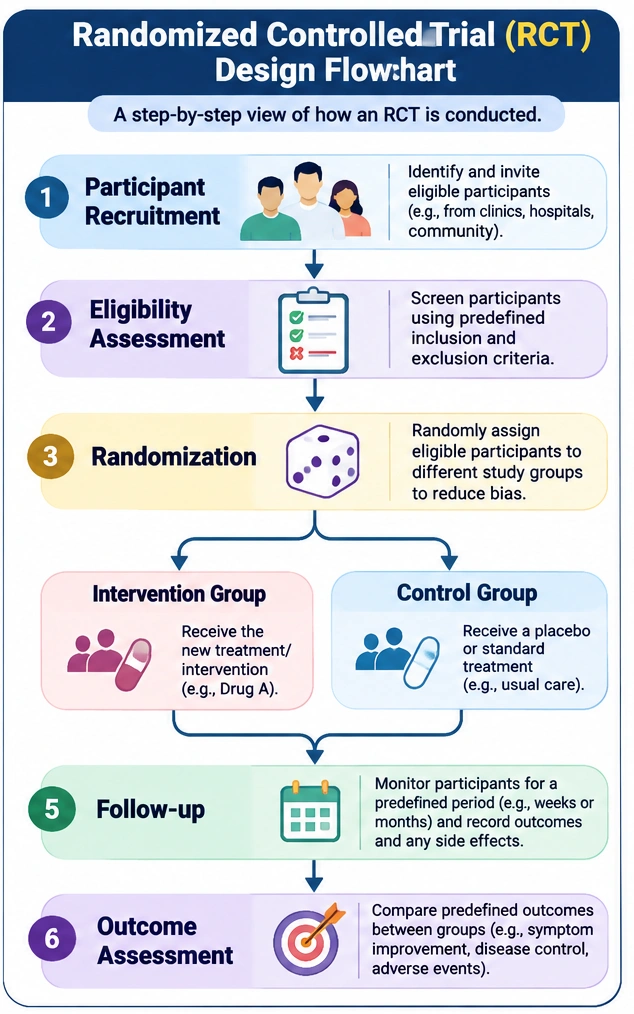
Steps in Designing a Randomized Controlled Trial
Each decision feeds into the next.
Step 1. Formulate a Clear Research Question
Start by turning your idea into a PICO question.
| Component | Meaning | Example |
| P | Population | Adults with hypertension |
| I | Intervention | New antihypertensive drug |
| C | Comparison | Standard medication |
| O | Outcome | Reduction in systolic BP |
A written PICO tells you who to recruit, what to compare, and what to measure. It also shows whether an RCT is even possible.
Before finalizing your trial question, make sure you understand the difference between a research question and a hypothesis. Read our guide on research questions vs. hypotheses to learn how each one guides the direction of a clinical study.
Step 2. Select the Appropriate RCT Design
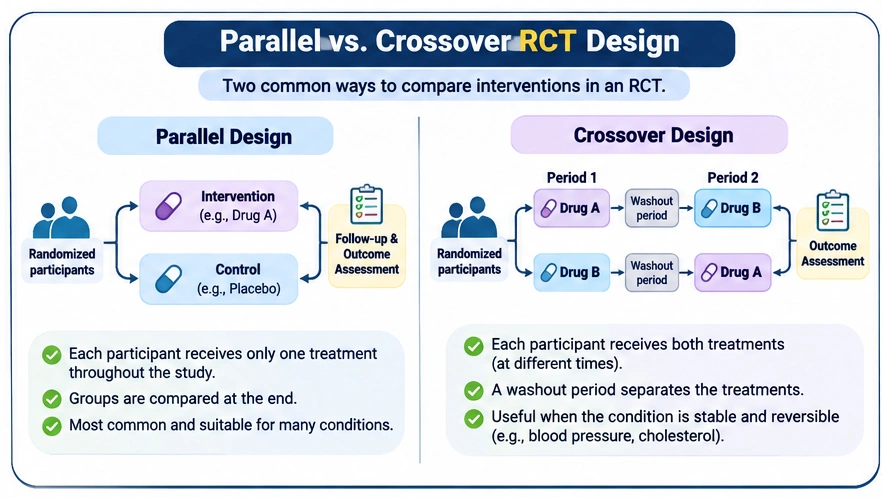
- Parallel-group: each person stays in one group from start to finish.
- Crossover: each person gets every treatment in random order, usually with a washout break between.
- Cluster: you randomize whole groups, like clinics or villages, instead of individuals.
- Factorial: you test two or more interventions in the same trial.
| Feature | Parallel RCT | Crossover RCT |
| Assignment | Separate groups | Same participants get all treatments |
| Washout period | Not needed | Often needed |
| Best for | Acute and chronic conditions | Stable conditions with reversible effects |
| Main concern | Differences between groups | Carryover and period effects |
There are fewer required in a crossover trial as each person serves as their own control. They are not valid if the effect of a treatment persists after the treatment or if the disease evolves during the study.
Step 3. Establish the Study Population and the Eligibility Criteria
Who can be in the study? For the trial:
Inclusion: Adults, 18-75, with a systolic BP of 140-179
Exclusion: Pregnant, severe renal disease, recent stroke
Choose your recruitment sites (outpatient settings), how you will obtain informed consent, and how you will ensure your study will be repeatable and prospective and how its results will be applied.
Step 4. Explain what the Intervention, Control Group, and Outcomes are
Describe the intervention, which can be reproduced by another team, including the name of the drug, dose, and frequency/duration. Only use a placebo if there is no effective treatment. If not, a comparison group should be obtained.
Choose the outcome you are most interested in (in this case, the reduction in SYS BP at 12 weeks). Other effects may be changes in diastolic and side effects. Before deciding on the sample size, decide on your primary outcome because the sample size decides how much change you will need in the outcome to show that there is improvement.
Build Strong Research Foundations
Learn to Plan and Design Clinical Research Studies
A well-designed randomized controlled trial starts with a clear research question and a sound methodology. Strengthen your understanding of study design, research methods, and protocol development through AARA’s research methodology training.
Explore Research Methodology CourseStep 5. Calculate the Sample Size and Statistical Power
If too small, you may miss a true effect. If too large, you increase risk to additional people for no reason. The sample size for an RCT is determined using:
- The expected effect size (the smallest difference that is important in clinical practice)
- The significance level (usually 0.05)
- The statistical power (often 80% or 90%)
- The outcome’s variability (often the standard deviation)
- The anticipated drop out rate
- The allocation ratio (often 1:1)
Example: It is expected the systolic BP will decrease by an average of 5 mmHg per group (based on a standard deviation of 15 mmHg) with an alpha of 0.05 and 80% power. The sample size for each group would be 142. A 10% anticipated dropout would add an additional 15 individuals to each group for a total of 158 individuals per group.
Other outcomes, such as continuous, binary and time-to-event outcomes require different methods of calculation. A biostatistician or statistical software should be used for more complex calculations.
The calculation method depends on your study design, primary outcome, and planned statistical test. For a more detailed explanation, explore our guide to sample size calculation for clinical research, including effect size, statistical power, and G*Power.
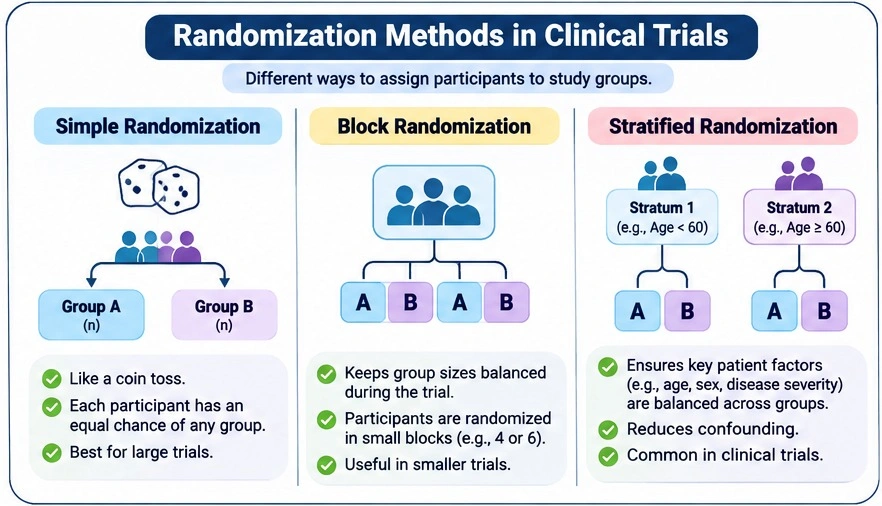
Step 6. Choose the Appropriate Randomization Method
| Method | How it works | When to use |
| Simple | Each participant assigned independently | Large trials |
| Block | Keeps group sizes balanced over time | Small or moderate trials |
| Stratified | Balances important baseline factors | Strong prognostic factors, like age |
| Cluster | Randomizes whole groups | Hospital or community interventions |
Use a computer-generated sequence. Alternation or assignment by date of birth isn’t true randomization, because staff can guess who’s next.
Step 7. Plan Allocation Concealment and Blinding
Allocation concealment keeps whoever enrolls patients from knowing the next assignment. Use central phone or web randomization, or sequentially numbered, opaque, sealed envelopes handled strictly.
Blinding hides which treatment someone got after randomization. It can cover participants, care providers, outcome assessors, and data analysts. Identical-looking placebo tablets make this possible in drug trials.
| Allocation concealment | Blinding |
| Before and at assignment | After assignment |
| Prevents selection bias | Reduces performance and detection bias |
You often can’t blind participants in surgical, behavioral, or lifestyle trials. You can usually still blind whoever measures the outcome.
Step 8. Develop the RCT Study Protocol
The protocol is your trial’s rulebook. It explains how the trial will be run, monitored, and analyzed. To write an RCT study protocol, cover:
- Title, background, objectives, and hypothesis
- Design, setting, and eligibility criteria
- Intervention, comparator, and outcomes
- Sample size calculation
- Randomization, allocation concealment, and blinding
- Statistical analysis plan
- Ethics, safety monitoring, and adverse event reporting
The 34-item SPIRIT 2025 checklist is a good guide here. It now includes open science and patient and public involvement.
Step 9. Secure Ethical approval and Register the Trial.
Submit your protocol to an Institutional Review Board (IRB) or research ethics committee and adhere to Good Clinical Practice (GCP) with your protocol.
Before enrolling the first participant in the trial, register the trial in a public registry, such as ClinicalTrials.gov. The majority of journals will not publish a late trial.
Before recruiting participants, researchers must understand the ethical review process and the documents required for approval. Read our guide on how to get IRB approval for research to understand the application process, protocol requirements, and review stages.
Step 10. Perform Trial and Plan Statistical Analysis
Recruit, consent, randomize, and administer treatments in a manner as outlined in the protocol. Monitor for adherence and adverse events and gather data in both groups in the same manner.
The overwhelming majority of trials report the results of intention-to-treat (ITT) analysis. All participants have been analyzed in the group they were randomized to, regardless of whether or not they completed the study. Per-protocol analysis excludes those who did not follow the protocol. It’s mentioned alongside ITT, but can introduce bias back in. Finalize analysis plan prior to viewing unblinded results.
How to Ensure Quality and Reduce Bias in an RCT
Bias is much easier to prevent at the design stage than to fix later. Before you recruit anyone, make sure your trial has:
- Proper randomization and allocation concealment
- Blinding wherever feasible
- A prespecified primary outcome and analysis plan
- An adequate sample size
- A plan to monitor protocol adherence
Two updated guidelines help you report all this clearly. SPIRIT 2025 covers what goes into a trial protocol. CONSORT 2025 is a 30-item checklist, with a participant flow diagram, for reporting a finished trial. Keep in mind these are reporting guidelines. Ticking every box won’t rescue a badly designed trial. To judge bias in published trials, reviewers use a different tool called RoB 2.
When evaluating published randomized controlled trials, researchers also need to assess whether the study findings may be affected by bias. Learn how the RoB 2 tool assesses risk of bias in randomized controlled trials and how its domains guide evidence evaluation.
Common Mistakes to Avoid When Designing an RCT
- Recruiting before ethics approval and registration. It puts participants at risk, and many journals won’t publish a trial registered after enrollment started.
- Going too small on sample size. An underpowered trial can miss a real effect, leaving you with an unclear answer after years of work.
- Mixing up allocation concealment and blinding. A trial can be fully blinded and still have selection bias if the allocation wasn’t concealed.
- Picking a weak primary outcome. If the outcome is vague or doesn’t matter clinically, your results won’t answer your question.
- Skipping a prespecified analysis plan. Choosing tests after seeing the data opens the door to selective reporting and makes results look stronger than they are.
Frequently Asked Questions
Q1. What are the key components of a randomized controlled trial?
Create a PICO question, select the design and establish eligibility criteria. Explain intervention and outcomes, determine sample size, and design randomization, concealment and blinding. Then write protocol, obtain ethics approval, register the trial, conduct and analyze the trial.
Q2. What is the sample size for an RCT?
An expected effect size, alpha, power, variability of outcomes, and dropout rate will be required. These are transformed into a number per group by using statistical software or a biostatistician. The approach is based on the type of the outcome: continuous, binary, or time-to-event.
Q3. What’s the difference between allocation concealment and blinding?
Allocation concealment prevents the recruiters from becoming aware of the next assignment until someone has registered. The treatment is blinded following the process of randomisation.
Q4. What are the most typical randomisation techniques used in clinical trials?
The most common are simple, block, stratified and cluster randomization. In smaller trials, groups are kept balanced through the use of block and stratified randomization.
Q5. What’s the difference between parallel and crossover RCTs?
In an parallel RCT everyone receives one treatment. Each subject receives all treatments at random in a crossover RCT, typically with washout periods in between.
Q6. Does CONSORT need to be used in all RCTs?
There is no legal requirement for this, as CONSORT is a reporting guideline. There are many journals that will require a CONSORT checklist to be included with its manuscript submission, but these rules can differ from one journal to the next.
Conclusion
Good randomized controlled trial design really comes down to careful planning. A clear question, the right design, enough participants, sound randomization, ethics approval, and honest reporting give you results other people can trust and build on. Work through these 10 steps, and check your plan against SPIRIT 2025 before you enrol anyone.
Want help designing your own study? Take a look at the research methodology courses at American Academy of Research & Academics and build your research skills one step at a time.
Sources
- Bhide et al. 2018, AOGS (St George’s open access copy)
- Randomised controlled trials: the gold standard for effectiveness research (UMN summary)
- CASRAI: Designing a clinical trial
Advance Your Clinical Research Skills
Make Better Statistical Decisions in Clinical Research
Understanding RCT design is only one part of conducting reliable clinical research. Develop your knowledge of statistical methods, sample size calculation, hypothesis testing, and data interpretation with AARA’s Biostatistics Online Course.
Explore the Biostatistics CourseDisclaimer:
Articles published by American Academy of Research & Academics are prepared by our team using information from direct experience, publicly available resources, and educational references. AI tools may be used to assist with drafting, proofreading, and formatting; however, all content undergoes review and approval before publication.
The information provided is intended for educational purposes only. Requirements, policies, and processes may change over time. Readers should consult official sources for the most current information.