
Introduction
A research question asks what you want to find out. A hypothesis states what you expect to find. Most students can repeat that distinction and still write the wrong one into a proposal, partly because supervisors tend to ask for “your research question and hypothesis” in a single breath, as though every study is supposed to carry both.
The confusion turns into a real problem at the methods stage. A question tells your reader what you are exploring. A prediction tells them what your statistics are going to test. When the two get mixed up, the halves of your protocol stop matching, and that shows up quickly in a thesis, a dissertation, or a manuscript under review.
This guide covers both terms with examples from medical, clinical, and psychology research, along with the situations where you only need one of them.
Research Question vs Hypothesis: What’s the Difference?
| Research Question | Hypothesis |
| Asks what you want to investigate | Predicts what you expect to find |
| Usually written as a question | Written as a statement |
| Does not have to predict an outcome | Makes a testable prediction |
| Used in both qualitative and quantitative research | Most common in quantitative research |
| Guides data collection and analysis | Guides hypothesis testing |
| May explore experiences or perceptions | Usually specifies expected relationships between variables |
A research question points toward an investigation. A hypothesis commits to an answer that your data are capable of rejecting.
Something beginners usually don’t know is that plenty of studies never need a hypothesis at all. A cross-sectional survey describing how many interns report burnout is answering a question, not testing a prediction. Once you start comparing two groups, estimating an effect size, or running a t-test, a hypothesis becomes necessary, because the statistical test has nothing to evaluate without one. For a closer look at when a hypothesis is expected at all, see what is quantitative research.
The deciding factor is usually the literature. If published work already gives you grounds to predict the outcome, write a hypothesis. If you cannot predict it with any confidence, a research question is the more honest choice, and no reviewer will penalize you for it.
What is a Research Question?
A research question is the one question your study exists to answer. It fixes the boundaries of the work: what you’re studying, who you’re studying, and what you plan to measure. Your sample, your methods, and your analysis all trace back to it.
Good questions tend to share a few traits. They stay on one issue instead of three. They can be answered with data you’re actually able to collect. They’re specific about population and setting, they matter to somebody other than you, and they fit the time and money you have. Frameworks like PICO can help here, see how to write a PICO research question for a step-by-step method with worked examples.
Plenty of researchers run a draft question past the FINER criteria:
- Feasible: you can realistically pull it off
- Interesting: someone besides you cares
- Novel: it adds something
- Ethical: it will clear ethical review
- Relevant: the answer changes practice or points to the next study
In medical research, feasibility and ethics usually do most of the filtering, since patient access and approvals decide what’s even possible.
Example: Does regular physical activity reduce perceived stress among medical students?
The researcher wants to know whether exercise and stress are linked here. Notice the question doesn’t pretend to know the answer yet.
What is a Research Hypothesis?
A hypothesis is a specific, testable prediction about a relationship or difference between variables.
Two terms do the heavy lifting. The independent variable is what you change or compare. The dependent variable is the outcome you measure. Those two, plus anything else you record along the way, make up your research variables.
Example: Medical students who exercise regularly will report lower perceived stress than students who do not exercise regularly.
Pull it apart:
- Independent variable → physical activity
- Dependent variable → perceived stress
- Population → medical students
- Predicted direction → less stress in the active group
The prediction is specific enough to fail, and that’s the real test. If no result you can imagine would contradict your statement, you haven’t written a hypothesis yet.
One more thing. A hypothesis isn’t a hunch. It should come out of published evidence, theory, or earlier work, and you have to be able to test it with the data you’re planning to collect.
Research Question vs Hypothesis Examples
Example 1: Medical research
Research question: Is sleep duration associated with academic performance among medical students?
Hypothesis: Medical students who sleep fewer than six hours per night will have lower academic performance than students who sleep seven or more hours.
The hypothesis picks a cutoff and calls a direction. That’s what makes it testable.
Example 2: Clinical research
Research question: Does intervention X improve blood pressure compared with standard care?
Hypothesis: Patients receiving intervention X will have a greater reduction in systolic blood pressure than patients receiving standard care.
Look at what changed. “Improve blood pressure” is vague. Systolic reduction is a number you can go measure.
Example 3: Psychology
Research question: Is social media use associated with anxiety among college students?
Hypothesis: Higher social media use will be associated with higher anxiety scores among college students.
Anxiety scores, not anxiety in general, which tells the reader a measurement tool is involved.
From problem to hypothesis
Most projects narrow through three steps:
Research problem: Stress is common among medical students.
Research question: Is exercise associated with stress levels among medical students?
Hypothesis: Medical students who exercise regularly will have lower stress scores than those who don’t.
Walk your own topic down those steps. If it survives, you have a direction.
Research Question vs Hypothesis in Qualitative Research
Qualitative studies almost always start with research questions instead of formal hypotheses, and the reason is practical. This kind of work explores experiences, perceptions, beliefs, barriers, and motivations. You’re trying to understand them from the participant’s side. Deciding the answer beforehand would defeat the point.
Example: How do international medical graduates experience the US residency application process?
The researcher might run interviews here and use thematic analysis to pull out common themes.
Compare that with the quantitative version: International medical graduates who complete structured residency-preparation programs will report higher interview confidence scores. Now there’s a measurable difference being predicted, so it’s a hypothesis.
Worth adding a caveat, though. Some qualitative and mixed-methods studies do carry hypotheses. It’s a pattern, not a rule.
Types of Research Hypotheses
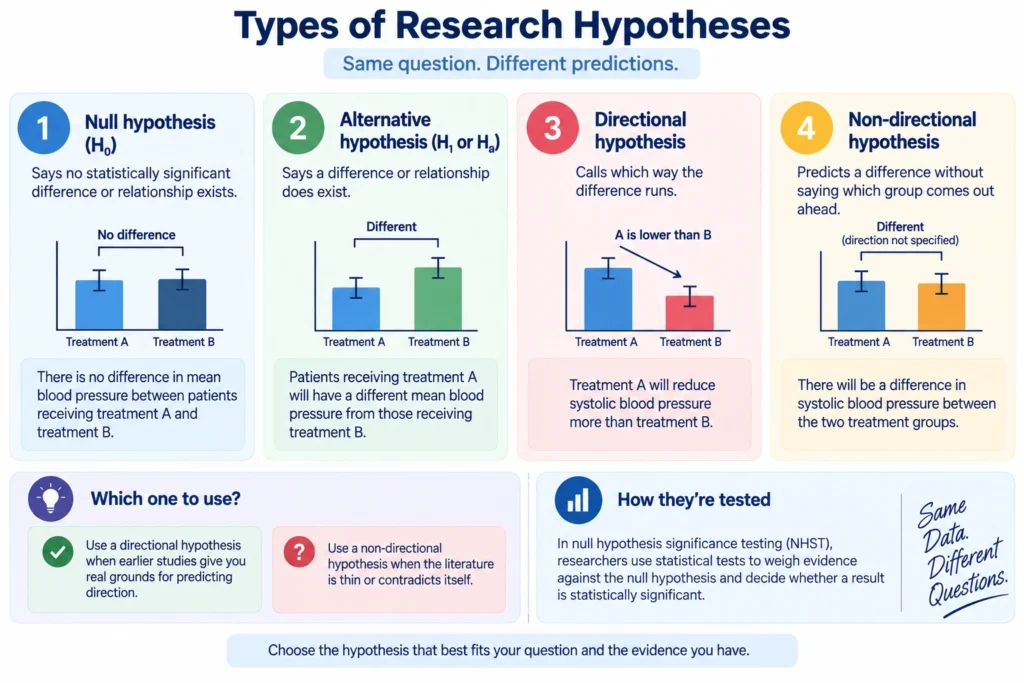
Four types show up in most papers.
1. Null hypothesis (H₀)
Says no statistically significant difference or relationship exists.
There is no difference in mean blood pressure between patients receiving treatment A and treatment B.
2. Alternative hypothesis (H₁ or Ha)
Says a difference or relationship does exist.
Patients receiving treatment A will have a different mean blood pressure from those receiving treatment B.
3. Directional hypothesis
Calls which way the difference runs.
Treatment A will reduce systolic blood pressure more than treatment B.
4. Non-directional hypothesis
Predicts a difference without saying which group comes out ahead.
There will be a difference in systolic blood pressure between the two treatment groups.
Go directional when earlier studies give you real grounds for predicting direction. When the literature is thin or contradicts itself, non-directional is the safer call.
In null hypothesis significance testing (NHST), researchers use statistical tests to weigh evidence against the null and decide whether a result counts as statistically significant. Choosing the right test starts with your outcome type, which statistical test to use in medical research breaks down how continuous and binary outcomes lead to different analyses.
Biostatistics
Your hypothesis is the thing the statistics are built to attack.
Null versus alternative, directional versus not, one tailed versus two. Each choice changes the test you run and how the result reads. Learn what is happening underneath the p value and the wording of your hypothesis stops being guesswork.
How to Write a Research Question
Five steps:
- Name the research problem. What gap are you responding to?
- Decide what you want to know. One thing, not four.
- Pin down population and context. Who, where, when?
- Make every term measurable. If you can’t measure it, rewrite it.
- Run it past FINER. Fix whatever fails.
A rough formula to start from:
What, How, and Does + variable or phenomenon + population + context?
Example: Does sleep duration affect academic performance among medical students?
Wording shifts with your study design, so treat that as scaffolding rather than a template.
How to Write a Hypothesis
Once the research question is settled, this part goes quickly.
Formula: Among [population], [independent variable] is expected to [relationship or difference] with [dependent variable].
Example: Among medical students, greater physical activity is expected to be associated with lower perceived stress.
Then check it against this list. A solid hypothesis is:
- specific about variables and population
- testable with the data you’ll actually collect
- measurable through a defined tool or outcome
- tied back to your research question
- backed by existing knowledge
- suited to your study design
And don’t write one just because you assume every paper needs one. A hypothesis bolted onto a study that was never designed to test it is easy to spot and hard to defend.
Research Methodology
When the two get mixed up, the halves of your protocol stop matching.
A reviewer notices that in about a minute. Question, objectives, design, variables, analysis plan. They either line up or they do not, and it is far cheaper to get that right at the proposal stage than to rebuild a methods section after submission.
Research Question vs Hypothesis vs Research Objective
These three get treated as interchangeable far too often.
| Element | Main purpose | Example |
| Research problem | Identifies the issue or gap | Medical students experience high stress |
| Research question | Asks what you want to find out | Is exercise associated with stress levels? |
| Research objective | States what the study will do | To examine the association between exercise and stress |
| Hypothesis | Predicts the expected finding | Exercise will be associated with lower stress |
Easiest way to keep them straight: the question asks, the objective plans, the hypothesis predicts.
Common Mistakes Beginners Make
Too broad a question
What affects medical students? No study design on earth answers that.
An untestable hypothesis.
Exercise is good for students. Good how, measured with what?
An objective wearing a hypothesis costume.
To determine whether exercise affects stress. That’s what you’ll do, not what you expect to find.
Assuming every study needs a hypothesis.
This one catches exploratory and qualitative projects constantly, where a question was the right choice all along.
Frequently Asked Questions
Q1. Is a research question the same as a hypothesis?
No. The question asks what you want to investigate. The hypothesis predicts the result.
Q2. Which comes first?
The research question. A hypothesis follows once the study is built to test a specific prediction.
Q3. Can qualitative research have a hypothesis?
Usually it works from research questions, though mixed-methods and some qualitative designs do include them.
Q4. What is the difference between a null and an alternative hypothesis?
The null says no difference or association exists. The alternative says one does.
Q5. Do all studies need a hypothesis?
No. It depends on your question, your methodology, and your study design.
Final Thoughts
Understanding these concepts early can save you from rewriting your methods section later. Start with the question, decide honestly whether your design calls for a prediction, and only then write the hypothesis. If you would rather learn it with feedback than by trial and error, the American Academy of Research and Academics runs a Basic Research Methodology Course for students and clinicians working on their first studies, covering research design, methodology, and publication.
Research Courses
The question asks. The objective plans. The hypothesis predicts.
Everything after that is a sequence of decisions that follow from the three. Which design your question implies, how many participants it needs, which test fits the outcome, whether the evidence already exists and should be synthesised instead of collected again.
AARA runs a separate course for each stage: research methodology, biostatistics, narrative review, systematic review and meta-analysis. Start wherever you are stuck rather than at the beginning.
Disclaimer:
Articles published by American Academy of Research & Academics are prepared by our team using information from direct experience, publicly available resources, and educational references. AI tools may be used to assist with drafting, proofreading, and formatting; however, all content undergoes review and approval before publication.
The information provided is intended for educational purposes only. Requirements, policies, and processes may change over time. Readers should consult official sources for the most current information.