
If you’re writing your first systematic review, PRISMA is going to come up fast. Most journals ask for a completed checklist before your manuscript even reaches a reviewer. Some reject submissions that arrive without one. This guide covers the PRISMA 2020 checklist, the flow diagram, and the two extensions you’ll probably need, without the jargon.
What Is PRISMA?
PRISMA stands for Preferred Reporting Items for Systematic Reviews and Meta-Analyses. It’s a reporting guideline. Not a method.
That distinction trips up almost everyone the first time. PRISMA won’t tell you how to run your review. It has nothing to say about which databases to pick or whether to use a random-effects model. What it does is tell you what to write down afterward, so another researcher can trace your steps and land where you landed.
The original version came out in 2009 and worked fine for a while. But review methods kept moving. People started using screening software, pulling from preprint servers, searching trial registers. The 2009 checklist didn’t really account for any of it.
PRISMA 2020 closed those gaps. It asks for more on your search, more on how you screened, and more on any automation you leaned on. The wording is also just plainer, which helps.
Why Is the PRISMA 2020 Checklist Important?
There’s a reason it caught on so quickly.
Your reporting gets tighter, for one. The checklist makes you state things you’d otherwise gloss over, like why you dropped a particular full text or where your protocol lives. Your review also becomes reproducible, which is the whole point. Someone should be able to take your paper, rerun your search, and end up with the same studies.
Then there’s the practical side. Journals list PRISMA under submission requirements, so skipping it can get your paper bounced before anyone reads it. And most reviewer comments on systematic reviews come down to missing methods detail. PRISMA handles those questions before they’re asked.
One thing to keep straight: PRISMA says nothing about whether your review is any good. It only checks whether you reported it fully. A shaky review can still tick every box.
Understanding the PRISMA 2020 27-Item Checklist
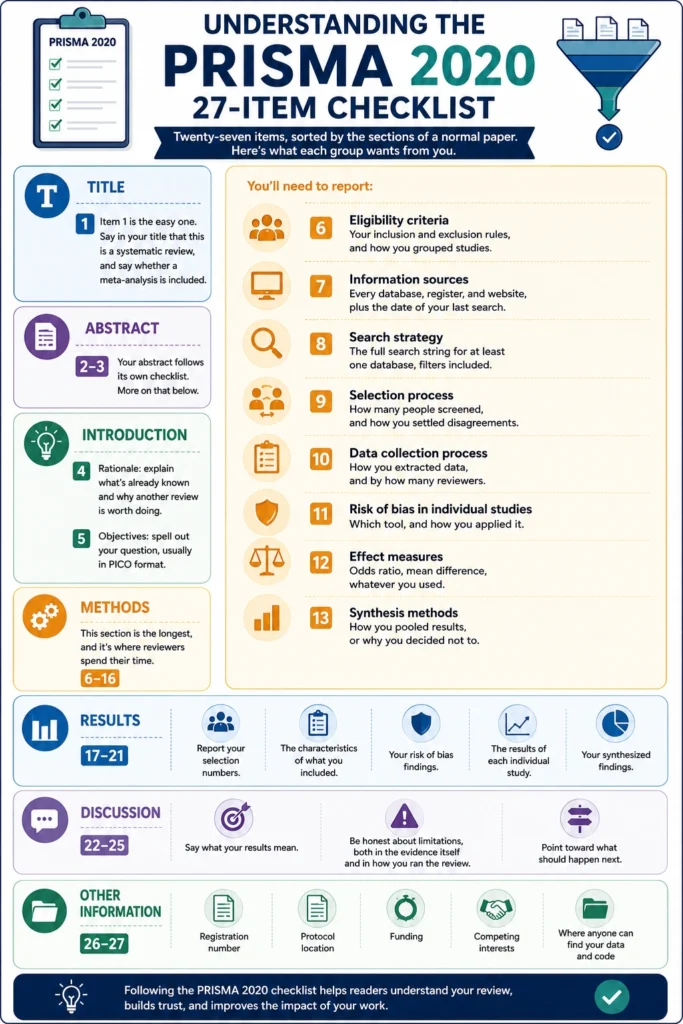
Twenty-seven items, sorted by the sections of a normal paper. Here’s what each group wants from you.
Title
Item 1 is the easy one. Say in your title that this is a systematic review, and say whether a meta-analysis is included.
Abstract
Your abstract follows its own checklist. More on that below.
Introduction
Two items. The rationale explains what’s already known and why another review is worth doing. The objectives spell out your question, usually in PICO format.
Methods
This section is the longest, and it’s where reviewers spend their time. You’ll need to report:
- Eligibility criteria, your inclusion and exclusion rules, and how you grouped studies
- Information sources, every database, register, and website, plus the date of your last search
- Search strategy, the full string for at least one database, filters included
- Selection process, how many people screened, and how you settled disagreements
- Data collection, how you extracted data, and by how many reviewers
- Risk of bias, which tool, and how you applied it
- Effect measures, odds ratio, mean difference, whatever you used
- Synthesis methods, how you pooled results, or why you decided not to
Results
Report your selection numbers, the characteristics of what you included, your risk of bias findings, the results of each individual study, and your synthesized findings.
Discussion
Say what your results mean. Be honest about limitations, both in the evidence itself and in how you ran the review. Point toward what should happen next.
Other Information
Registration number, protocol location, funding, competing interests, and where anyone can find your data and code.
Systematic Review
Twenty-seven items, and eight of them sit in Methods.
That’s where reviewers spend their time, and where reviews come apart. Eligibility criteria, search strategy, dual screening, risk of bias, synthesis, every one of those is a decision made months before the checklist opens.
The PRISMA Flow Diagram Explained
The flow diagram is one figure that follows every record from your first search down to your final included studies. Four stages.
Identification
How many records you found, broken down by source. Databases in one box, trial registers in another, and anything you picked up through citation chasing or emailing authors in a third.
Screening
Duplicates removed first. Then the number of titles and abstracts you screened, and how many you knocked out at that stage.
Eligibility
How many full texts you went looking for, how many you couldn’t get hold of, and how many you actually assessed. Every exclusion here needs a reason attached to a number. Something like “wrong comparator, n = 9.”
Included Studies
Your final count for qualitative synthesis, and a separate count for meta-analysis if you ran one.
Journals want this figure because it’s the quickest possible audit. An editor can scan it and spot a number that doesn’t add up in about five seconds.
What Is PRISMA-S?
PRISMA-S is an extension built just for search reporting. It exists because searches were, for years, the worst-reported part of published reviews.
It asks for every database and platform you used, the dates you ran each search, your complete search strings copied exactly as you ran them, any filters or limits, and how you deduplicated along with the software you used.
All of it comes down to reproducibility. A search nobody can repeat is a search nobody can verify. Most journals let you park this in a supplementary file.
What Is the PRISMA Abstract Checklist?
Plenty of readers never get past your abstract. Journals know that, which is why structured abstracts following PRISMA are now standard at a lot of them.
The checklist covers your objectives, eligibility criteria, information sources with your last search date, your risk of bias method, your main results with effect estimates and confidence intervals, your key limitations, and your registration number.
It’s short. It’s also easy to fumble. Write the abstract last, then go through the list line by line.
Common Mistakes Beginners Make When Using PRISMA
A few patterns show up over and over.
Treating PRISMA as a methodology is the classic one. It’s a reporting tool. Your actual methods come from somewhere like the Cochrane Handbook. Related to that: some authors describe their screening numbers in the text and skip the diagram entirely. Most journals will send it back.
Exclusion reasons get left out a lot too. Every full text you rejected needs a reason and a count. You have to paste your whole search string, one line wont work.
Protocol registration is another easy miss. Register on PROSPERO before you start screening, then report the number. And don’t ignore your supplementary files; that’s where your search strings and extraction sheets belong.
The biggest mistake, though, is opening the checklist after you’ve finished writing. Use it from day one and the write-up gets much less painful.
Research Methodology
Opening the checklist after you’ve finished writing is the expensive mistake.
Missing exclusion reasons, an unregistered protocol, a search string nobody can rerun, none of these are fixable at submission. They’re decisions made in week one. Build the habit before you build the review.
Final Thoughts
PRISMA is there to make your review transparent and repeatable. Nothing more complicated than that. Treat it as a planning document rather than a box you tick at the end, and keep it open while you write.
Put PRISMA 2020, the flow diagram, PRISMA-S, and the abstract checklist together and you’ll be close to submission ready.
First review? Take it one item at a time. It gets easier quickly.
Meta-Analysis
“Synthesis methods” is one line on the checklist and three months of work.
How you pooled results, or why you decided not to. Effect measures, fixed versus random effects, heterogeneity, publication bias. Twelve weeks, worked through with real datasets and a mentor who has published them.
Frequently Asked Questions
What is PRISMA 2020?
It’s the current reporting guideline for systematic reviews and meta-analyses. It replaced the 2009 version, with clearer wording and new items covering search reporting and automation tools.
How many items are in the PRISMA checklist?
Twenty-seven in the main checklist. The abstract checklist is separate and has 12.
What is the PRISMA flow diagram?
A figure showing where every record went, from identification through screening and eligibility to final inclusion, with exclusion reasons at the full-text stage.
What is the difference between PRISMA and PRISMA-S?
PRISMA covers the whole review. PRISMA-S is an extension that deals only with how you report your literature search.
Is PRISMA mandatory for systematic reviews?
No rule says you must use it, but many journals won’t accept a review without it. In practice, assume it’s required.
Can PRISMA be used for narrative reviews?
No. It’s built for systematic reviews and meta-analyses. Narrative reviews have separate guidance, such as SANRA.
Disclaimer:
Articles published by American Academy of Research & Academics are prepared by our team using information from direct experience, publicly available resources, and educational references. AI tools may be used to assist with drafting, proofreading, and formatting; however, all content undergoes review and approval before publication.
The information provided is intended for educational purposes only. Requirements, policies, and processes may change over time. Readers should consult official sources for the most current information.