If you’re an IMG staring down Step 1, your head is probably full of questions. Where do you even start? Three months or six? How many UWorld questions is enough? And now that the exam went pass/fail, does any of this even matter anymore? Take a breath. This guide walks you through a plan that works, one step at a time.
Why Your Step 1 Study Plan Matters Even Though the Exam Is Pass/Fail
“Pass/fail” throws a lot of people off. They hear it and assume the exam got easier. It didn’t. The content is still huge, and most IMGs spend months getting ready before they feel steady walking in.
What really trips students up is treating Step 1 like the finish line. It isn’t. The effort you put in now follows you around. A solid base gives you a real head start on Step 2 CK, which carries serious weight in your application these days. It sharpens your clinical reasoning, makes research papers easier to follow, and helps you hold your own during clerkships.
Flip that around and the picture gets rough. Students who cram their way through on a shaky foundation tend to hit a wall later, right in the middle of Step 2 prep. Yes, only a pass shows up on your report. But how well you actually learn this material shapes everything that comes after it.
Read our guide on How Many Hours a Day Should You Study for USMLE Step 1?
Before You Start: Assess Your Current Level
Before you lock in a timeline, figure out where you actually stand. The simplest way is a baseline self-assessment. Sit for an NBME practice test, a UWorld self-assessment, or a diagnostic exam, and get an honest number to start from.
That number does most of the deciding for you. Score low, and you might need eight months. Score well, and three could be plenty. There’s no universal answer here, only the one that fits you.
Your circumstances count too. A fresh graduate with the basics still fresh is in a very different spot from a working doctor squeezing in study hours, someone knee-deep in internship, or a grad coming back after years away. Be honest about which one is you.
Free mentor guidance
Not sure which timeline actually fits you?
Most IMGs misjudge their starting point by about two months. Share your baseline NBME score with our team and a mentor will tell you honestly whether 3, 5, or 8 months is realistic.
Ideal USMLE Step 1 Timeline for IMGs
Once you know your starting point, you can match it to a timeline that makes sense. Most IMGs land in one of three groups.
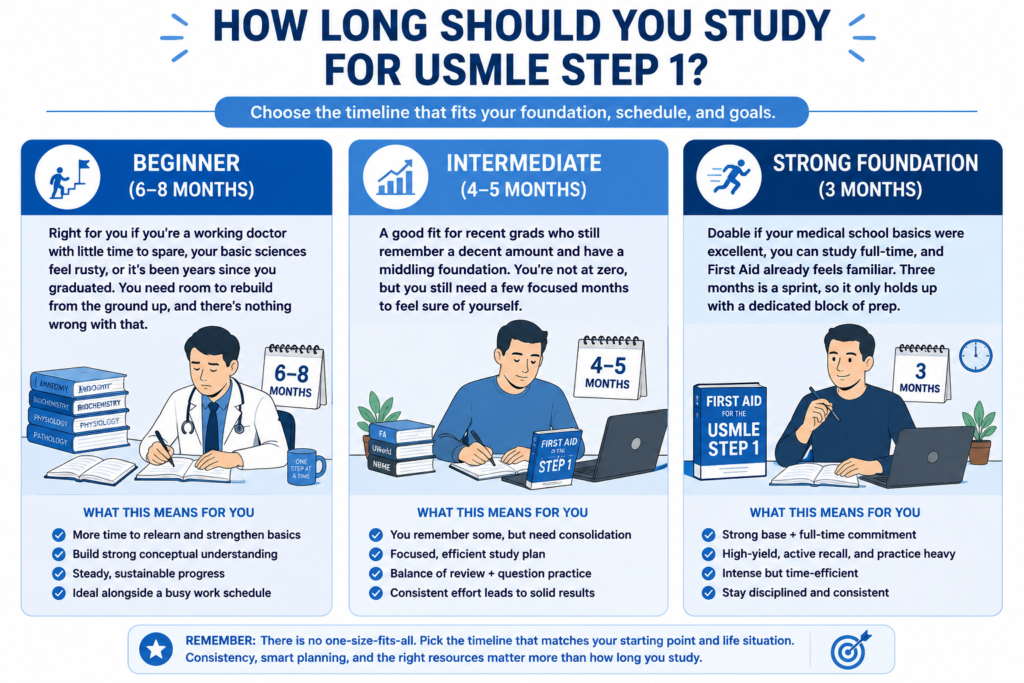
Beginner (6–8 months). Right for you if you’re a working doctor with little time to spare, your basic sciences feel rusty, or it’s been years since you graduated. You need room to rebuild from the ground up, and there’s nothing wrong with that.
Intermediate (4–5 months). A good fit for recent grads who still remember a decent amount and have a middling foundation. You’re not at zero, but you still need a few focused months to feel sure of yourself.
Strong foundation (3 months). Doable if your medical school basics were excellent, you can study full-time, and First Aid already feels familiar. Three months is a sprint, so it only holds up with a dedicated block of prep.
Here’s a quick gut check:
Go with the timeline that matches where you really are, not the one you wish fit.
The Best 3-Month Step 1 Schedule (Week-by-Week)
Got a strong base and full days to study? Here’s a three-month plan to keep you moving.
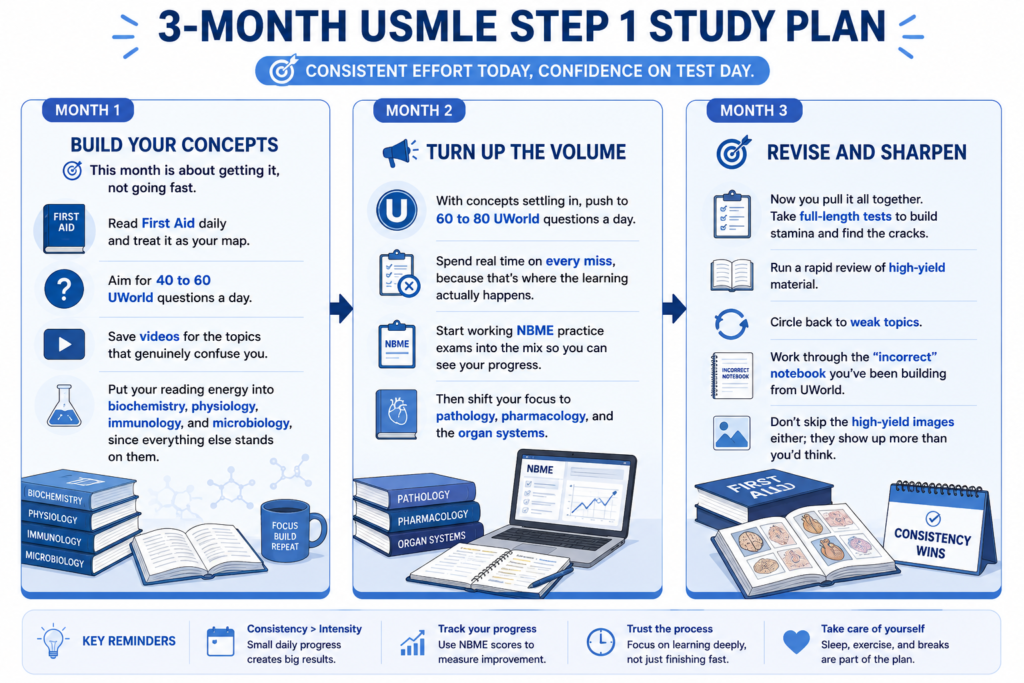
Month 1: Build your concepts. This month is about getting it, not going fast. Read First Aid daily and treat it as your map. Aim for 40 to 60 UWorld questions a day, and save videos for the topics that genuinely confuse you. Put your reading energy into biochemistry, physiology, immunology, and microbiology, since everything else stands on them.
Month 2: Turn up the volume. With concepts settling in, push to 60 to 80 UWorld questions a day. Spend real time on every miss, because that’s where the learning actually happens. Start working NBME practice exams into the mix so you can see your progress. Then shift your focus to pathology, pharmacology, and the organ systems.
Month 3: Revise and sharpen. Now you pull it all together. Take full-length tests to build stamina and find the cracks. Run a rapid review of high-yield material, circle back to weak topics, and work through the “incorrect” notebook you’ve been building from UWorld. Don’t skip the high-yield images either; they show up more than you’d think.
Keep this checklist handy as you go:
- Finished a full UWorld pass with careful review
- Read First Aid at least twice
- Completed several NBME practice exams
- Built and reviewed an “incorrect questions” notebook
- Took one or two full-length tests
- Reviewed high-yield images and weak topics
Follow the plan, but stay loose. If your practice scores say a subject needs more time, give it more time. No plan is worth clinging to when the numbers are telling you something.
USMLE Preparation Course
A schedule is easy. Sticking to it isn’t.
Our USMLE prep course turns this plan into a week-by-week structure with mentor check-ins, NBME score reviews and a written action plan for your weak subjects.
How to Use First Aid for USMLE Step 1 Effectively
First Aid will be one of your most-used books, but only if you handle it right. The classic mistake is reading it cover to cover like a textbook. That’s not what it’s built for, and honestly, it’s a slog that doesn’t stick.
Treat it as something you work with, not just something you read:
- Annotate it with notes pulled from your practice questions
- Tie each page to what UWorld explanations teach you
- Highlight only the concepts that keep coming back
- Go through it several times instead of once
A rhythm that works well is three passes. The first read just gets you familiar with the layout and flow. The second is where you fill gaps and scribble in your own notes. The last one, close to exam day, is a fast review to lock in quick recall.
Bottom line: First Aid earns its keep as a partner to your questions, not a book you sit down and read on its own. The tighter you link it to real practice, the better it holds.
What UWorld Percentage Should IMGs Aim For?
This might be the most-asked question of all, and the honest answer catches people off guard: your UWorld percentage on its own won’t tell you whether you’ll pass. It’s a learning tool first, not a report card.
So stop staring at the number. Learn from every question, read the explanations like they matter, and build up your pattern recognition. That’s the stuff that actually moves you forward.
Still, a few rough benchmarks can help you place yourself:
- Under 50% means the core concepts still need work
- 55 to 65% means you’re climbing and headed the right way
- 65 to 75% means you’re in a strong learning stretch
- 75% and up means you’re well prepared, as long as you got there fair and square
And one point worth saying twice: one slow, careful review of a question block beats blasting through hundreds of questions just to nudge a percentage up.
Resources You Actually Need (Avoid Resource Overload)
When it comes to Step 1 resources, less really is more. Plenty of students hoard every book and video they can find, then drown in options and fall behind. A small, focused toolkit beats that every time.
Here’s what you actually need:
| Must Have | Optional |
| First Aid | Sketchy Pharm |
| UWorld | |
| Pathoma | |
| Sketchy Micro | |
| NBMEs |
These few cover just about everything the exam throws at you. Piling on extra materials usually slows you down instead of helping. Pick your set, trust it, and go deep rather than wide. You’ll cover more that way, not less.
Common Mistakes IMGs Make During Step 1 Preparation
Even hardworking students fall into the same traps. Keep an eye out for these:
- Hoarding resources. More books don’t mean more knowledge. Usually they just mean more confusion.
- Putting off UWorld. Starting questions late is a regret you hear constantly. Begin before you feel ready.
- Memorizing instead of understanding. Step 1 rewards reasoning. Pure memorizing tends to fall apart on exam day.
- Skipping NBMEs. They show you where you really stand. Don’t dodge them just because the truth feels scary.
- Ignoring weak subjects. The topics you avoid are usually the ones begging for attention.
- Comparing yourself to everyone else. Your timeline is yours. The only score to beat is your last one.
- Studying without revising. Learning something once won’t cut it. Revision is what makes it stay put.
Steer clear of these and you’ll save yourself weeks of wasted effort, plus a good chunk of stress.
The mistake this list misses
Waiting until after Step 1 to start research
Program directors screen for publications. IMGs who begin research during dedicated prep enter the Match cycle with output already indexed on PubMed. Ours runs alongside Step 1 at about four hours a week.
Frequently Asked Questions
Is 3 months enough for USMLE Step 1? Yes, if you’ve already got a strong foundation and can study full-time. Most IMGs need a bit longer, depending on where they’re starting from.
Can an IMG pass Step 1 on the first attempt? Yes. Thousands of IMGs do it every year with a solid study plan, steady practice, and regular self-assessment.
How many hours should I study daily? It depends on your situation. Full-timers usually put in 6 to 10 focused hours a day. If you’re working, 2 to 4 focused hours works fine; you just stretch the overall timeline to match.
Should I finish UWorld before taking the exam? Ideally, yes. One full pass with careful review usually does more for you than rushing through several.
Is Step 1 still important after becoming pass/fail? Definitely. Strong Step 1 prep builds the base you’ll lean on for Step 2 CK and your rotations, even though only a pass gets reported.
Conclusion
No single timeline fits everyone. The right plan is the one built around your honest starting point, so pick a schedule you can actually stick to. While you study, keep understanding ahead of memorizing, because that’s what carries you through the exam and everything after it.
Keep your resources tight and consistent, and lean on UWorld and First Aid together instead of treating them as separate chores. Let NBMEs track your progress, and adjust whenever the scores point you somewhere new. Above all, aim for a routine you can keep up, not a flawless one. Start sketching out that schedule today, and take it one steady day at a time.
Residency Match Guide for IMGs
Step 1 is one milestone, not the goal.
Clinical experience, research, ERAS timelines and mock interviews all decide where you match. Our complete roadmap walks you through every stage in order.
If you’d rather not figure it out alone, the American Academy of Research and Academics is here for exactly that. We support IMGs at every stage of this roadmap, from clinical experience and research to ERAS support and one-on-one mock interviews. Visit our website to see how we can help you match.
AARA Membership
One membership, every course.
USMLE preparation, research methodology, biostatistics and systematic review, plus mentor access and certification, bundled into a single membership plan.
Disclaimer:
Articles published by American Academy of Research & Academics are prepared by our team using information from direct experience, publicly available resources, and educational references. AI tools may be used to assist with drafting, proofreading, and formatting; however, all content undergoes review and approval before publication.
The information provided is intended for educational purposes only. Requirements, policies, and processes may change over time. Readers should consult official sources for the most current information.